Showing posts with label Food. Show all posts

Monday, March 25, 2013

A film shoot

One of the research methods I was most excited to try during my field season here in the Philippines was something called participatory videography.

Participatory videography is a variation of the photo voice method. (If you've seen the film Born into Brothels it's the same kind of method.) Photo voice is a process in which participants are asked to capture their personal perspective on a particular topic using photography, with the goal of identifying, representing and improving their community. The photographs are later used as the basis for a critical discussion, either as part of a group workshop or a dialogue with decision-makers. In my study, a small group of participants create videos instead of taking pictures. The videos will be used to explore the various places environmental migrants go following a calamity, and the livelihood changes they have experienced.

For many reasons (which I will not elaborate upon here), the process of doing participatory videography has turned out to be very different from what I'd anticipated. The revised version, I think (and hope), will yield good results.

On Friday, my research team set out with a small group of research participants to trace key elements of their journey as environmental migrants. I hope this entry will give you a glimpse into the types of research activities we are doing here. Instead of going into the minutiae, I've opted to write in note form and let the photos fill in the details.

*      *      *      *
5:43 am
My internal alarm clock goes off. Must be nerves about the day's activities. There's no way I'm falling back asleep.

6:20 am
A forrest yoga podcast to start the day (and an extra half hour sleep for Ada and Frank).

7:00 am
Plain instant oatmeal, hard boiled eggs, banana and mango for breakfast. No time to make (brewed) coffee. Frank double checks to make sure he has the GPS (aka Samsung Galaxy smart phone with a GPS app). He's been assigned to be the official coordinate-taker at each site.

8:00 am
Meet up with Dudong, our jeepney driver neighbour. I'd arranged a pakyaw deal in which I hire him and his jeepney to take us around for the day's activities at a set price. He's wiping down the long benches running lengthwise along each side of vehicle. He runs back into his house to change from his pyjama-shorts into old jeans and a t-shirt. We are en route in the emptiest jeepney we've ever been in within 15 minutes.
Our jeepney for the day

8:45 am
After snaking our way through morning traffic, and a short stop to top up the oil, we arrive at the Park Cafe in Divisoria. We're picking up Kuki, my translator and research assistant extraordinaire. I send her a short text message telling her to look for us in a white and very empty jeep. Frank makes a quick trip into Dunkin' Donuts for some coffee.

9:15 am
Arrival at Ecoville. Only two diversions on the drive in (aka wrong turns). 

There are no staff on-site, and no group of participants waiting (as per our arrangements). Uh oh. 

We head to the carenderia of one of the participants who has agreed to come out on today's activity.  Communication about the plans broke down somewhere along the line ... A frantic "are any staff around?" text message to my contact.

The carenderia owner helps gather the other participants, while I go collect and pay for the snacks I'd ordered from the Ecoville cooperative. The coop manager informs me that they'd been instructed to make "hearty" and "filling" snacks. Great! 

10:00 am
Departure. There are thirteen of us: four adult women participants and two of their young children, two adult men participants, Kuki, Dudong, Frank, Ada and me. 
There's an air of excitement. Transport from Ecoville into the city is relatively expensive so it's a rare splurge for many of the Ecoville residents, particularly for those with no or sporadic employment. When Kuki explained the activity at a workshop last week, there was an enthusiastic response. It would be like a school trip - back to the sites of their old homes and the other places that had a significant impact on them in the months after Typhoon Sendong. It would also be an opportunity for them to learn more about their new neighbours and their pre-Sendong lives. Ecoville residents lived in many different barangays in the city before coming together and building a new community in Ecoville.

10:30 am
First stop is the Xavier Heights covered court. It's a few side streets off the national highway in barangay Balulang. A goat grazes at the edge of the property. A half-dozen boys play basketball in the covered court.

We all dismount and tour the site. Kuki interviews one woman who lived her from December 2011 until February 2012. The army brought her here. We film on the spot where she and her family slept. It's right at the edge of the basketball court, on the grass side.
Xavier Heights covered court
On the walk out, a group of men stop Frank, and inquire about our activities. Upon hearing the interest in Typhoon Sendong, they offer an explanation on the root causes of the devastation: (illegal) logging, mining, unchecked development. Everyone, it seems, has an opinion on the calamity.

11:20 am
It's a harrowing ride through the backroads of Balulang down to Isla Puntod, the former home of two of the women. The road is used mostly by big trucks carrying crushed gravel from the river quarries. Much of the soil was carried away with the floodwaters, leaving only large boulders and giant potholes. Dudong's grimace tells me he was not anticipating this kind of off-road driving when he quoted me his pakyaw price.

There used to be two bridges connecting Isla Puntod to the mainland, a hanging bridge for pedestrians and a cemented bridge for motors (motorbikes), quarry trucks and the multicabs that served as the main mode of public transportation here. The former bridge was completely washed out and has not been rebuilt. The latter is cracked and doesn't look like it could stand another flood, but is still used. Looking at the river and the main Taguanao bridge upstream, it's easy to see that Isla Puntod would inevitably be flooded if the river level ever rose. There is no other place for the water to go. During Sendong, the water rose to within one meter of the bridge.
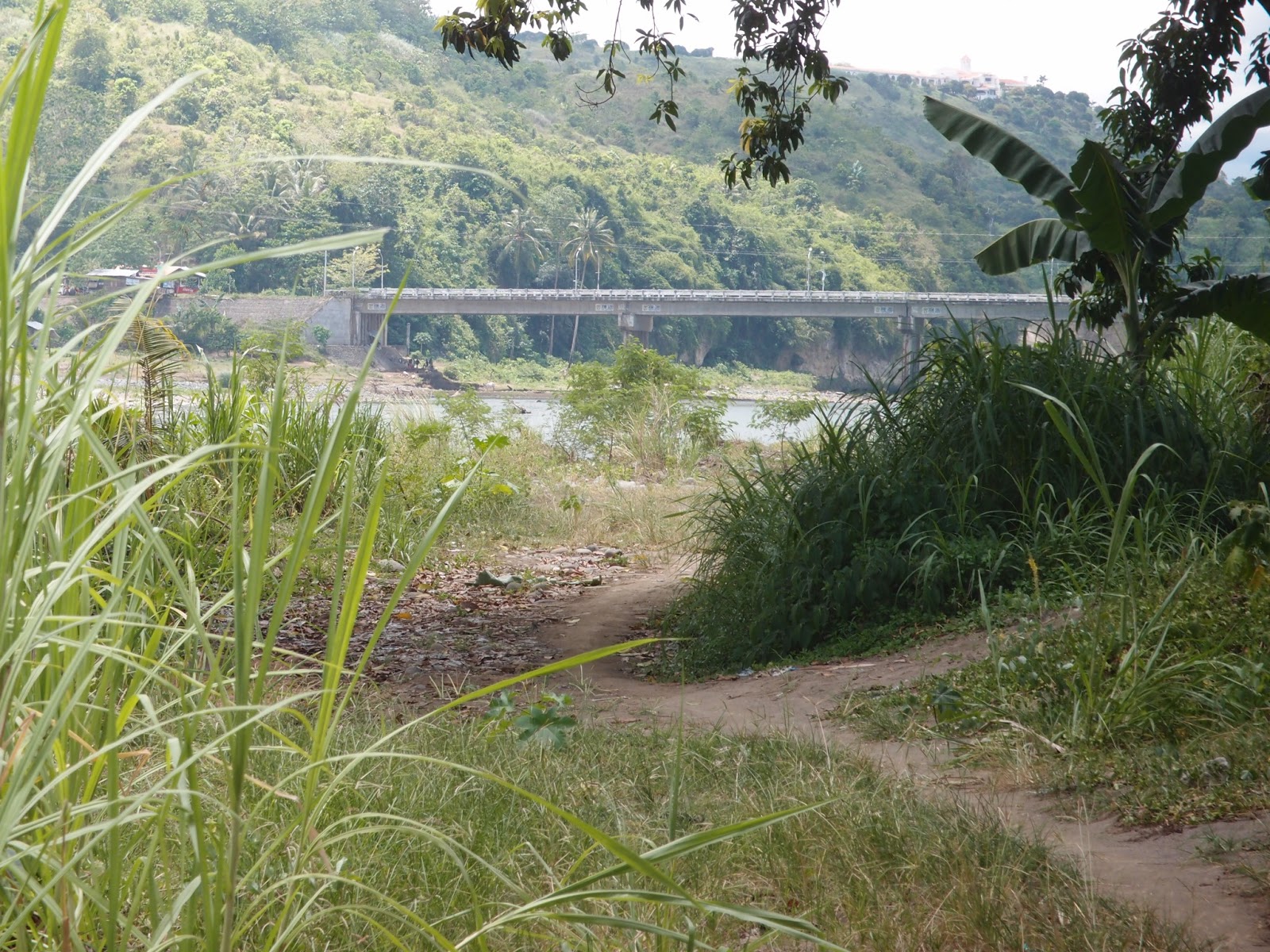
Taguanao bridge over the Cagayan River
Yet, the lots on Isla Puntod were titled. And there used to be plenty of houses.One woman moved here in 2003, paying a monthly mortgage of 116P to eventually own the land. Her place was connected (legally) with electricity in 2008. She will not receive any reimbursement for the money she has paid for the lot.

We film in front of her old house. She points to the site where a coconut tree once stood. When the water began rising (up to 25 feet), she and her husband climbed the tree to escape . The tree was knocked over by a barrage of uprooted trees. It was very dark so they kept shouting "where are you?". They crossed from one treetop to another, eventually making it to the safety of a neighbour's place several hundred meters away. 

Her family has rebuilt a nipa house. They return occasionally to harvest mangoes, papaya, kamote and other vegetables and root crops. It's very peaceful; the river air and breeze is welcome respite from the summer heat.

The only new structure on the Isla is on a quarry site. The building serves as an office. Quarrying activities continue unabated.
Quarry next to the river
Isla Puntod is now a no-build zone. On the drive out, the women wave to old neighbours relaxing in hammocks hanging from a mango tree outside their concrete house. 

12:00 pm
Drive into the city, into traffic. Turn left off Borja Street onto Isla de Oro. A young mother used to live here with her family. She tells Kuki about her old home.

Meanwhile, Frank strikes up a conversation with a group of lechonero, the men who prepare lechon. Roasted pig, or lechon, is a specialty of Cagayan de Oro City and a favourite dish of Cagayanos during holidays, graduations and fiestas. The men are resting in the shade of a light, open structure. Two lechon are skewered onto long bamboo poles, ready for hours of roasting. It turns out that the men are (English-speaking) environmental migrants, so I go to interview them.  

Lechonero with their lechon
The men used to live in Isla de Oro, but have since been relocated to the Chinese houses in Cala-anan. Even though they have been relocated, they return to Isla de Oro on a daily basis ... for work. Lechon-making is the main livelihood of these men's families. Holidays is a particularly busy time for them. Sometimes they receive orders from Manila; to get the cooked lechon to the Lumbia airport in time for the afternoon flight, the lechonero must start preparations at 3am. There are no jeepneys running from Cala-anan to the city at a quarter past two in the morning, so the men have no choice but to spend the night in Isla de Oro. 

The men compare levels of theft in Isla de Oro and in Cala-anan. Theft, they say, is much higher in Cala-anan. They attribute this to poverty and unmet basic needs at the relocation site.

The entire Isla de Oro is now a no-build zone.

12:40 pm
The next stop is Isla Delta in barangay Consolacion. 

The young mother who used to live here talks rapidly. She calls cheerfully to former neighbours who seem happy to see her. 

She points out the spot where her amakan house once stood. It's just past a junk shop and adjacent a small creek whose waters are more stagnant than flowing. The water is barely visible under a thick mass of bright green aquatic plants. The house was given to her from the Celebration Church. She lived at the house for 15 years. 

A two minute walk away is her brother's house. She returns here on a regular basis to visit family; she sleeps here whenever she comes into the city. The house has a concrete foundation and amakan walls on the upper floor. He continues to stay here with his family, even though they have a bunkhouse (temporary shelter) in Ecoville. They will move permanently to Ecoville once the construction of the permanent houses is complete.
Under the Marcos bridge
We continue walking and stop under the Marcos bridge. She returned here on a daily basis to collect relief goods given by the Catholic Church and some non-governmental organizations. 

Across the dirt road is a giant billboard. On the night of December 16-17, 2011, her mother and cousin were carried by the flood waters and stranded in the struts of the billboard. Luckily, they survived. 
Billboard where several survivors were trapped
We leave on a somber note. She points to a stretch of road where the bodies were laid out, brought there by members of the police and armed forces. In the days after the calamity, families gathered on the bridge and looked down, trying to identify loved ones.

Most of Isla Delta is now a no-build zone.

1:15 pm
We drive past the pier and into barangay Macabalan. Most of the houses are constructed with light materials. It is densely populated, and lacking in trees and greenspace. It's an estuary barangay, located at the meeting of the Cagayan River and Macajalar Bay. Salty air wafts into the jeepney. It's a refreshing change from the diesel, charcoal and refuse stench in the downtown core.

The roads are very narrow with deep gutters on either side. It is barely wide enough for the jeepney to pass. Dudong demonstrates his expert driving skills when he is forced to creep around a wake extending onto the street. Kuki explains that when someone dies, there is usually a wake in which family, friends and neighbours come to pay their respects (and maybe share a shot of Tanduay rum). In poorer neighbours, where most people have tiny houses with very limited space for accommodating visitors, these wakes extend onto the street. It is socially acceptable to appropriate this public space for the duration of the wake.

We shoot a video looking out onto the river. The former resident explains that his house was built on a seawall and extended over the river. It was entirely washed out. All along the river side of the road are empty concrete house ruins and newly planted vegetable gardens. Children play in the abandoned houses. On the other side of the road is a thriving community - sari-sari shops, carenderias, residential homes, etc. No building is vacant.
Frank takes the GPS coordinates where the house once stood
Many of his former neighbours are waiting to be relocated to the Cala-anan and Indahag relocation sites. Initially, no Macabalan residents were supposed to be given relocation housing, even though many of houses were washed out. The city's rationale was that nobody in the barangay died in Sendong. It took a very tragic incident for this position to change. One woman died by suicide in an evacuation center; she had been denied relocation housing because she was a renter and not a home owners, was too traumatized to return to her old place, and felt she had no alternative. The Catholic parish priest in Macabalan was afraid that his parishioners may follow a similar fate, so he lobbied the city on their behalf, advocating for relocation. He is credited with helping a lot of (former and soon-to-be former) Macabalan residents.


1:45 pm
A quick stop at the Macabalan Elementary School where he stayed for two months, along with 74 other families. The guard recognizes him, and waves us in for the filming.

Macabalan Elementary School
2:00 pm
Everyone is getting hungry. The snacks were hearty and substantial, but a full meal is definitely warranted. On the drive to a favourite carenderia the Isla Delta woman points out a PhilPost building; it is where she comes each month to pick up the money she gets from the DSWD's 4P's program geared at helping low income families support the educational and nutritional needs of their children.

We make a quick stop at the Provincial Capitol to film where the same woman came each afternoon to collect relief goods. Government workers would distribute cooked food, a welcome respite from canned sardines and noodles.

2:45 pm
After a lunch of rice, chicken, porkchop, jackfruit salad, and squash and monggo bean soup, washed down with Pepsi, we are all in much better spirits. The weather, however, has taken a turn for the worse. It's clouding over. By the time we stop at City Central School - one of the main evacuation camps - it is pouring cats and dogs. It's the first all-out thunder and lightning storm we've seen in our time in CDO.
Filming in the rain
The rain abates ever so slightly for the video shoot. It is the only clip we do under umbrellas.

Kuki has to leave for another job, leaving us to finish the day sans-traductrice. Fortunately, everyone has a good sense of what to present at each site. Still, not being able to communicate fully does make the work more challenging.

3:10 pm
We drive through Macasandig, a relatively upscale barangay. Many of the barangay's middle-class residents were completely unprepared for Sendong because there had been no flooding there (in living memory).

It's still raining so we offer the older gentleman who lived here the option of filming from the jeepney. He walks with a cane and might have trouble navigating puddles. He insists on doing his part and filming on-site in the covered court where he and his wife stayed for several months.

3:45 pm
We finally arrive back at Ecoville, exhausted. We do a final video in one of the bunkhouses, where the Macabalan man and his family now stay. It's small but cheery. A motorcycle helmet hangs on one wall. Bags of donated clothes and linens line one wall. He narrates his video in a mixture of English and Visayan.
Alley behind the bunkhouses at Ecoville
After much thanks, hand-shaking and good wishes, we head back home.

*      *       *       *
The day is long, emotionally taxing and physically exhausting. And rich, revealing and rewarding.

I will go back to Ecoville again next week to deliver copies of the video to each participant. Before the videos can be shared with others outside the research team, they need to be translated, edited, and, in some cases, altered to conceal the identity of the participant (as per their request).


N.B. I have permission to use and share the pictures and stories of the people in this post. Sensitive  details have been omitted in order to protect the respondents.

Friday, March 22, 2013

Stinky fruit

The Philippines boasts myriad tantalizing tropical fruits. Some fruits grace North American and European grocery store shelves: yellow mango, banana (of all sizes), pineapple, papaya. Other fruits are harder to find outside of tropical countries, especially in their non-juice, non-dried form. Some examples include: mangosteen, breadfruit, lanzones, rambutan, jackfruit. Sadly (for tropical fruit gastronomes based in colder climes), the quality of such fruits diminishes rapidly with intercontinental travel, so a Philippine mango consumed in Canada is nowhere near as lami (Visayan word for delicious or sweet) as one consumed in the Philippines.

Of the more unusual fruit sold at local roadside fruit stands (and found in our fruit bowl), are two kinds that fall into the "stinky fruit" category:  marang and durian. 

Durian, in particular, emits an odour that is not merely mildly unpleasant, but (to many people) full on repulsive. For example, an ice cream parlour in Madison, Wisconsin once tried to create a durian-flavoured ice cream. Apparently, a neighbouring business, unfamiliar with the smell, called the fire department, complaining of a gas leak. After the arrival of fire trucks and a bomb squad, the parlour abandoned its recipe experimentation.

Personally, I consider other smells much more offensive (e.g. hockey gloves that have not been washed for several months or a car full of wet kayak gear in a July heat-wave). Frank disagrees. And so too, apparently, do many hotels and airlines, who single out durian and marang as banned substances. 
Lobby display at the Marigold Hotel in CDO
Here's an introduction to these two stinky fruits. 

A pile of marang 
Marang (Artocarpus odoratissimus) grows on a tree indigenous to the island of Minadanao. It is a relative of the breadfruit, but a much stinkier and smaller cousin. The outer skin is covered with short, flexible spikes; it bears an uncanny resemblence to an echidna (spiny anteater) balled up in a defensive position. The range in the size of these fruits is roughly the same range found in bowling balls. The fruit inside is composed of sweet, soft white-coloured segments, each around a hard inedible pit. 
Young woman eating marang
Durian (Durio spp.) is the king of stinky fruit. In the Philippines, it is grown almost exclusively in Mindanao. (There's debate over whether the fruit is native or was introduced.) It's pretty expensive as far as fruit goes. It retails for over 250P per kilo in the grocery store (inner fruit only). Buying whole fruits at the Cogon market or at a roadside kiosk is a more budget-friendly option (60-100P per kilo).
Durian vendor with her basket of fruit

The fruit has a hard green-brown exterior; its sharp spikes easily pierce through canvas grocery bags and the skin on your fingers. It's best to ask the fruit vendor to slice open the fruit before you buy. This reduces: 1) the chance of cutting your fingers and 2) the possibility of buying fruit with critters small enough to worm their way between the spikes and start devouring the soft flesh inside. 

There are several cultivars of durian. The one with white flesh has a lighter, more delicate taste. It's the preferred choice for those with a more sensitive nose. The yellow-fleshed durian has a bolder taste (and smell). The fruit itself is very creamy and rich; it melts in your mouth. It is very soft; its 'squishability' makes it an ideal baby food. (Mango and durian are tied atop Ada's list of favourite foods.)
A partially-eaten durian

If you ever find yourself with the opportunity to indulge in such delicacies, I highly recommend it ... even if you have to hold your nose the entire time.

Wednesday, March 6, 2013

Do you eat rice?

Amakan house
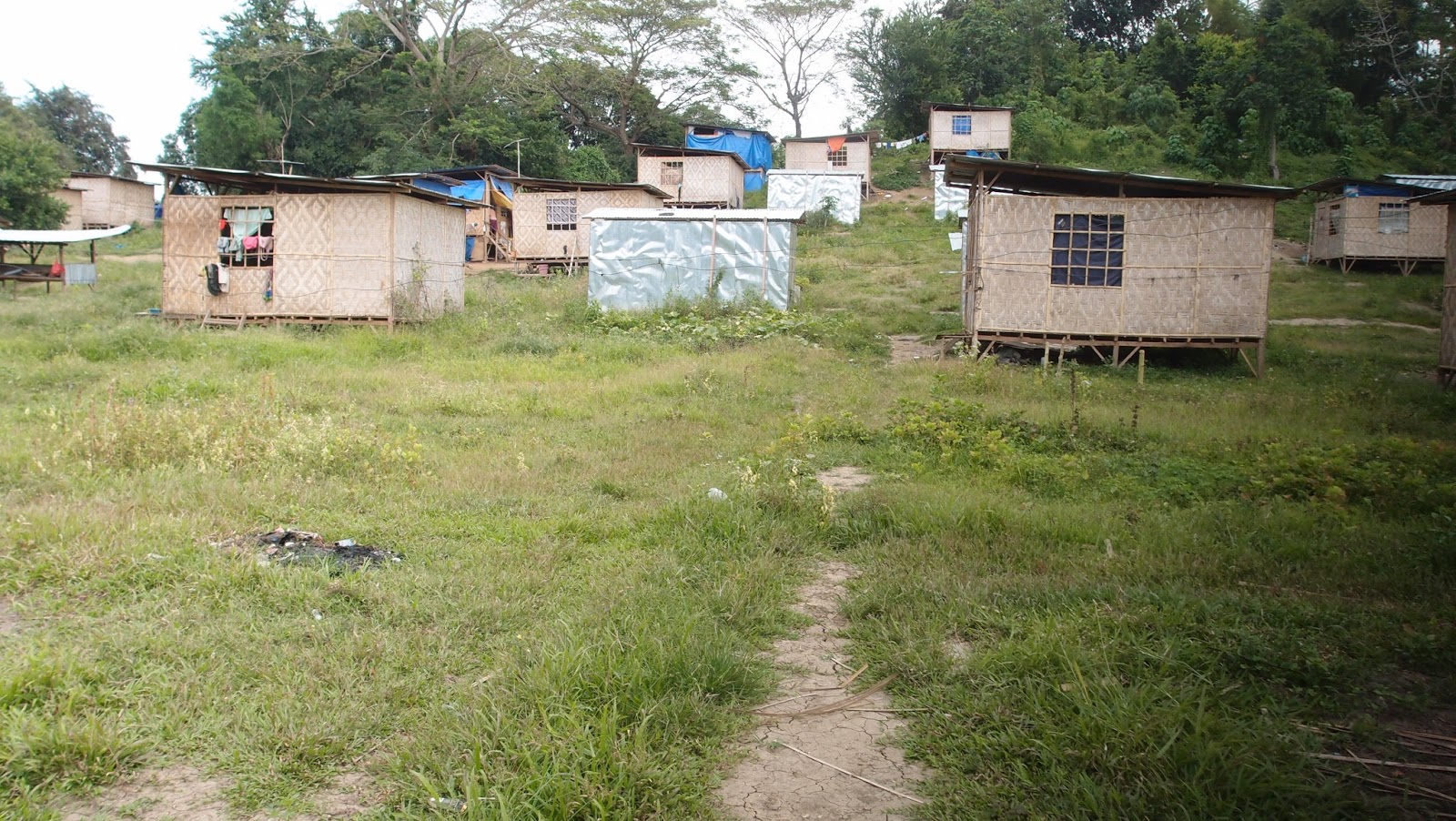
Today, my research team - an interpreter/research assistant, my daughter and I - visited an amakan village on the other side of the city. It's called an amakan village because the walls of the houses are made of amakan (bamboo). The walls are lightweight and well-suited to rapid construction and demolition - a key criterion of temporary housing. At its peak, the village housed over 200 households (roughly 1000 men, women and children survivors of Typhoon Sendong). Only 62 families currently reside there. The remaining families are scheduled to move into permanent relocation housing by April or June of this year.

Amakan houses and empty spaces where amakan houses once stood
The answers of the residents to my research questions were fascinating. It is not their answers, however, that I want to share in this post; it is their questions.

At the end of each interview and focus group discussion, I ask respondents what (if any) questions they have for me. About half of the respondents don't have any questions and prefer to move on with the rest of their day. Of the respondents who elect to pose questions, most inquire about the research itself or how I am enjoying life in the Philippines. If Ada is with me, then I am often asked "lalaki or babae?" (boy or girl), "how many months?", and "is the father Pinoy?". This 'second interview' typically lasts only several minutes.

Today, the second interview was much longer. There was a back and forth of questions, a comedic  performance, a round of pass-the-baby, and peals of laughter. I tried to answer the questions as fully and truthfully as I could but I didn't have all the answers. Here's a smattering of their queries.

They inquired about the Canadian climate and weather:
  • What kind of precipitation is there in Canada?
  • How cold is it?
  • Do you like snow and cold?
  • What are the seasons in Canada?
  • Do people freeze in the wintertime?
Other questions delved into family and personal matters:
  • Do you have more children?
  • How old are you?
  • Where do you stay here in the Philippines?
  • When did you arrive in the Philippines?
  • Where is your husband? What does he do here?
  • What is your husband's job? Does he have a salary here in the Philippines?
Then, there were the food questions:
  • Do you eat rice?
  • Why don't you eat rice three times a day?
  • What do you eat?
  • Is it true that there are people in the USA who only eat fruits and vegetables and bread?
  • What is your favourite Filipino food?
There were questions about social issues in Canada:
  • Are there poor people in Canada?
  • Is there a social safety net for poor people and unemployed people in Canada? Does the government provide them with free housing?
  • How does the welfare system work?
And, some questions about transportation:
  • How long does it take to get to the United States? By car? By plane?
  • Are there buses in Canada?
  • How do people travel long distances in Canada?
Other inquiries focused on their observations of foreigners (i.e. white) in the Philippines:
  • Why do foreign men like Filipina women? 
  • Why do foreigners always walk [instead of taking a motorella, jeepney, habal-habal (motorbike)]  even when it is so hot and only 7 to 10 pisos?
  • Why do American men walk so fast - like this [imitation of a man taking enormous strides]? His Filipina wife has to walk so fast just to keep up [imitation of a women hurrying around taking four or five tiny steps just to keep up with the husband], and she's usually pregnant [arm gestures to indicate a pregnant belly].
The questions you ask can reveal a lot about you, perhaps even more than the response. It's an issue I've considered in the process of designing and carrying out my research. In asking respondents to take a turn as the interviewer, I can learn about values, stereotypes, cultural biases, among other things. And, in answering questions, I can satisfy their curiosity and hopefully help to nurture cross-cultural understanding.

And now my closing questions to you:
  • How would you have answered the above questions?
  • What question(s) do you have?

Thursday, February 28, 2013

Tuesday run

Late Tuesday afternoon,
walking down Mahogany Road,
beads of sunscreen and sweat collecting dirt and car exhaust, I mull over the day's work.

It was a long day of interviews in barangay Carmen:
- the city police department
- the regional fire department
- sari-sari owners whose shops sport new renovations and fresh red and white paint courtesy of Coca Cola - a drunk trisikad (pedicab) driver trying to score a free ticket to Canada
- a thoughtful young trisikad driver
(The latter two, survivors of Typhoon Sendong)

A lunchtime discussion with my translator about the confused reactions of the trisikad drivers when asked the pros and cons of their livelihood:
"Why ask such a question? It's a job. If we don't work, we don't eat. There's nothing to like or complain about."

And one interview in the downtown hub of Divisoria
There was a late start to the interview with the director of the Xavier Ecoville Resettlement Site;
A visit from Philippine President P'noy to the resettlement site takes precedence.

Back at the house, there is a request for roasted manok (chicken) for dinner ...
It is Tuesday after all and we only buy rotisserie chicken on Tuesdays
"Why?"
It just happened that way, and is now an unofficial house rule.

The chicken is on the other side of the highway.
I volunteer to buy it on the way back from a run.

It's my first run in a few days.
The summer heat, a persistent cough, fatigue from nighttime nursing, and long days of interviews and note-writing have dampened by enthusiasm for early morning jogs.

I turn left onto the national highway, away from the city and towards barangays of Agusan and Puerto.
The shoulder is uneven, a mixture of broken asphalt, rocks and litter.
It is shared,
- by overloaded transport trucks waiting for the magical hour of 5 PM when the traffic cops call it a day and stop issuing tickets
- by jeepneys, motorellas, trisikads dropping off passengers and picking up new ones
- by roadside vendors selling everything from mosquito repellent and bananas to fresh fish and hair ties
- by schoolchildren and workers returning home
But no other runners.

A few K later I dash across to the road leading up to a new housing development.
The road is paved all the way up to Teakwood Hills;
A project of Congressman Rufus Rodriguez, according to the billboards.
The pavement ends less than one hundred metres past the gate.
There are residential roads inside, but only two houses.
But lots of vacant lots.

Not unexpectedly, the road to Teakwood Hills is hilly, steep in some parts and only a slight incline in others.
The road is marked with stations of the cross.
(Many roads branching off the highway and into the mountainous hinterlands are pilgrimage routes.)
By the time I pass Station III, my calf and hamstring muscles are burning.

A brief reprieve on some flats, where a group of children play.
Three boys and one girl are wearing only one slipper (flip flop);
The mates are on the road at varying distances from the children.
They play a version of bowling, in which the object of the game is to knock over a can with a pitched slipper. Another dozen or so children watch.

"Americano, Americano"

One of the boys abandons the game and joins me, matches me stride for stride.
We run one station of the cross together, then he stops.

On the way down, I spot the kids again.
They have been climbing up the hill.
All wear two slippers.
The boy rushes out in front, I slip in behind, and the rest of the kids behind me:
A parade, a posse of runners.
The laughter is louder than the footfalls.

A "whoooooshing" sound interrupts, then clippity-clop, clippity-clop, clippity-clop.
A tall chestnut mare gallops into the fray.
Luckily for us, she stays on the opposite side of the road.
She carries no rider, only a frayed rope tied around her neck.
The rope undulates at the same rhythm as her captive.
The equine gracefully exits the run.
The children follow.

The return trip is quick.
I feel lighter, even laden with manok.

Monday, November 19, 2012

Balut

Warning: This post may not be suitable for vegetarians and for people who prefer to forget the meat on their dinner plates was actually destined to be an animal.

If you're craving a small merienda (Tagalog for snack), you may be tempted to try a Pinoy specialty: balut. Balut are sold at semi-permanent roadside stalls or by roaming one-man sellers (the vendors are mostly men) who call out "baaaa-luuuuuut" in loud deep voices every few minutes. The eggs are usually carried in insulated styrofoam containers, about the size of a can of paint. Inside, the eggs are kept hot. The sellers also carry all the accouterments: salt, vinegar and chilies. Some sellers will also carry water and soap so you can wash your hands.
Balut container, chicharon snacks, salt and spiced vinegar
Balut are boiled duck embryos. On the outside, balut look just like hard-boiled eggs. To eat balut, you start by slurping up the 'soup' - the embryonic fluid. Next you peel away the eggshell until only a tiny sliver of shell remains at the bottom. Then, you sprinkle on some spiced vinegar, tilt your head back, pinch your nose and try not to think about what is coming next. Holding the sliver of eggshell, pop the embryo into your mouth and bite. You might be crunching on a beak and feathers, depending on the age of your balut. After the final swallow, you can eat a pinch of salt to slightly change the taste. Alternatively, you can add the salt at the same time as the vinegar.
Looking inside the balut
One of us (not yours truly) tried (albeit reluctantly, and with much goading from yours truly) balut. This is how the culinary adventure transpired.

After our pedicab ride, Goon asked us if we'd tried balut, then offered to have one with us. I politely decline and offer to photograph the experience instead. Frank agrees to partake in a small merienda feast. Goon buys two balut at 25 pesos apiece, then proceeds to explain and demonstrate the process. Of the experience, Frank recounts that "It just tastes like soup, like broth. It's more the texture that's different. The yolk is like biting through hard rubber."
Goon and Frank eating balut
If you're not convinced by the culinary appeal of balut, then perhaps another one of its attributes may convince you: it is a reputed aphrodisiac, and telling locals you've tried it instantly confers street cred.

Bon appétit!

Monday, October 22, 2012

A photo shoot in San Vincente

San Vincente is the second slum F has ever set foot in. The first was a short walk away from his resort in Venezuela. In the market there, you could score a bargain on a Poly Station. Not sure if it was compatible with Play Station games though. On one of his first days in the Philippines, F took photographs San Vincente.
The entrance gate to San Vincente
In politically correct terms, San Vincente is an "informal urban settlement". It's a lively hub of activity a block and a half from our current home in UP Village. Vendors hawk their wares and street food. Small sari-sari shops line the main road selling everything from rice, sachets of Datu vinegar, fresh fish and buko (fresh coconut) to hair clips, cell phone covers and secondhand clothes. Haircuts at the barber are a mere 50 pesos (PhP); pedicures will cost you slightly more. There's a laundry shop where the women will wash, dry and fold your clothes for 25 PhP a kilo.
Sari-sari shop

Just outside the gate separating San Vincente from UP Village, tricycle drivers sneak in catnaps between ferrying customers along Maginhawa Street to Philcoa. The drivers are mostly young men and very friendly. Some blare music from old radios, probably scrounged from recycled parts. The stench of dirty diesel 2-stroke engines wafts through the air.

Tricycle drivers
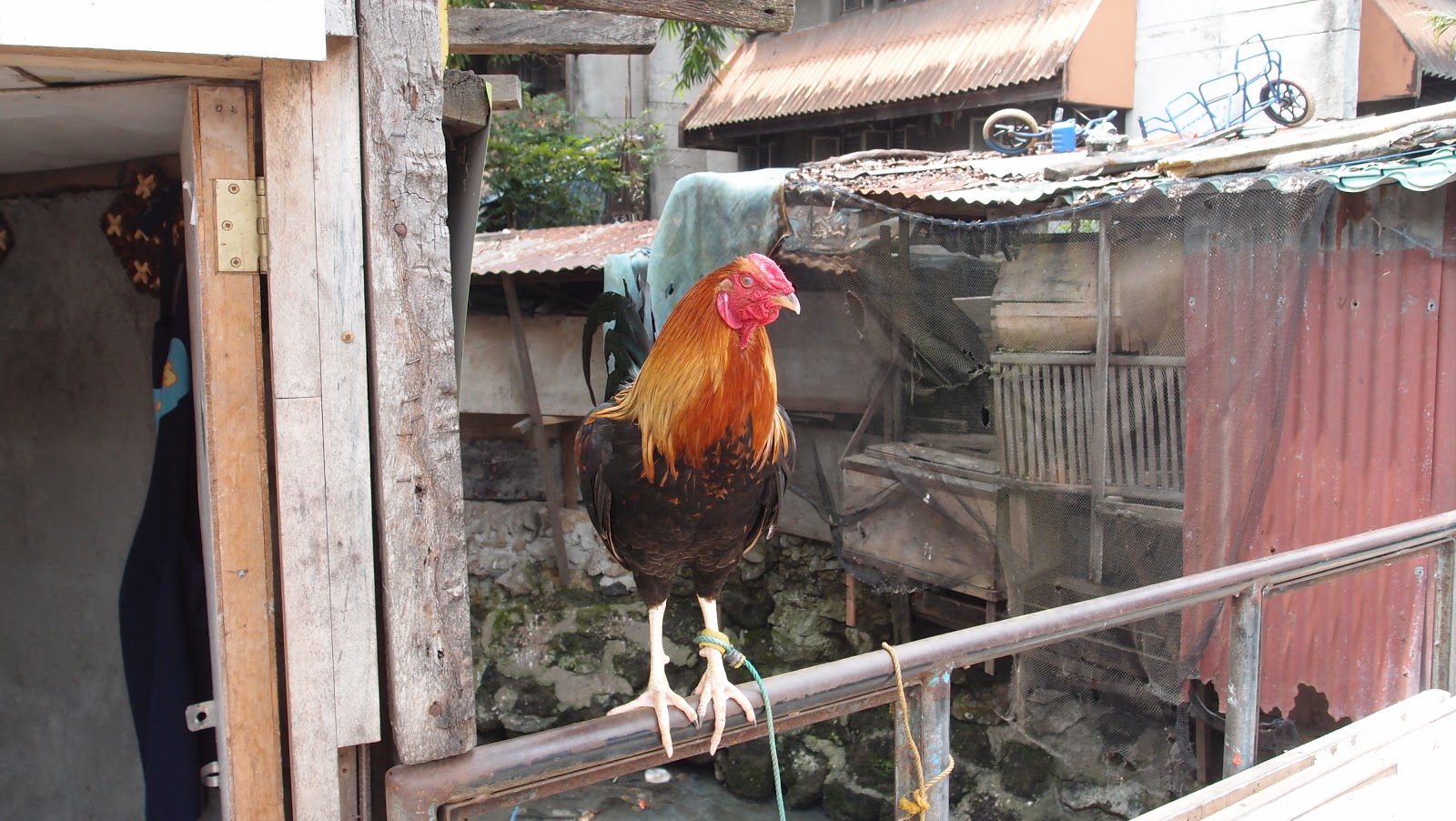
On the side of the street that receives the most shade are two wire mesh cages. Tethered to each is a handsome rooster. The black and white one is scrawny and shy. His counterpart is much more regal looking with his rich brown, black and green plumes and his slow and deliberate strutting. Both are being groomed as cock fighters.
Rooster on the bridge

The "residential area" is located adjacent to University Avenue. Houses are constructed out of corrugated tin, old pieces of plywood, tarpaulins, and other makeshift building material. There's electricity; some houses have lights, televisions, or even an imitation Play Station. It's cramped. Clothes lines stretch between roofs and trees, connecting neighbours in the daily airing of (previously) dirty laundry.
Laundry hanging out to dry

Everywhere there are children. Running. Skipping. Playing marbles. Laughing. Yelling. Shooting baskets. Carrying school books. Carrying younger children. Fetching this or that for an adult. Drinking soda from a plastic bag. Calling out to the "Americanos". Sneaking looks at the baby "doll".


Children walking to school
A small stream runs through San Vincente. It reeks of urine, garbage and rotting leaves. The stream forks somewhere between the footbridge and the shanties. Right now, there's a mere trickle of water, but whenever a typhoon rolls into Manila the trickle swells and swells and swells. It rises above all the houses, forcing residents into the safety of the second floor of the barangay hall.

San Vincente is a part of our daily lives. We hear the sounds of roosters at dawn (and every other time of day). I buy fresh buko on my way back from morning runs at UP. We stop and chat with the vendors on our way to and from the university. We bring our laundry to the laundry shop.* Someday (I hope), F or I will join the boys in a game of basketball. I chat with other young moms about their babies.

*        *         *        *

The cost of these pictures is 1,000 PhP - not because San Vincente residents demanded money in exchange for being photographed. In fact, many people excitedly asked him to take their picture. No, the fee was an unfortunate accident for F, and a lucky find for the person who found the crisp, bank-machine-ironed bill. From now on, cameras and loose bills will not share the same pocket.


* Well, everything but A's diapers, but more about our daily routine in another post.