Showing posts with label Livelihoods. Show all posts

Saturday, May 25, 2013

Catching pisos

I hesitate to write this post, and to upload these photos and video. Have hesitated for almost four months. Why? I don't want to reinforce "us and them" attitudes, or to create/perpetuate an orientalist (mis)understanding of the Philippines. 

(In 1978, the Edward Saïd published a book called Orientalism. In it, he describes orientalism as the subtle and pervasive prejudices against people of the Middle East. These prejudices romanticise (and caricaturise and even daemonise aspects of) Arabic culture, and are used to justify the colonial and imperial goals of Europe and the USA. The current US 'war on terror' is one example of how (neo) orientalism has real-life consequences today.)

Technically, from a geographical standpoint, harbouring 'subtle romantic yet harmful prejudices' about the Filipinos and Filipino culture cannot be orientalist because the Philippines is in Southeast Asia and not the Middle East. But, creating or reinforcing simplistic stereotypes can be just as detrimental.

So, with these caveats, here are some images snapped from aboard a ferry in Cebu City. 

In the hour between boarding and departure from the port an economic (and cultural) exchange takes place. 

Over the ferry intercom, an authoritative voice reminds passengers that they should not throw money at the people in the bangkas. Such actions can cause injury. The warning falls on deaf ears. Rather than dissuading passengers from engaging in such activity, the announcement seemingly has the opposite effect.  A large crowd appears on the starboard deck. The passengers empty the coins from their pockets and slip rolled bills into empty plastic drink containers. They scan the water below.

Ten bangkas putter up alongside the ferry, each carrying two to six people. They wear little and very lightweight clothing. No bathing suits. Most of the boats have both children (including infants) and adults. One young woman pauses during the exchange to nurse her baby.
Each boat has one or two 'catching tools'. These tools are made of an old rice sack or plastic canvas poster attached to two strong sticks, which enable a person to manipulate the catching tool. 
When a passenger tosses a coin or bill from the ferry, there's a flurry of activity. Often, the passenger makes a show of preparing to throw down money. One, two or three of the bangkas glide through the water nearing the passenger. The people below try to make eye contact with the passenger and unfurl their catching tool. The coin is tossed. If it lands in the catching tool, the catcher tilts the tool so the coin slides into the boat. If the coin misses, then one or several people will dive into the water to retrieve it. The water retrieval success rate is surprisingly (to me) high.
The exchange lasts thirty minutes. The ferry horn blasts. The passengers head back into their cabins, the cafeteria or the karaoke bar. The bangkas depart; some propelled by human paddling, others by motor.

What is your response to the images. Is it pity or guilt? Amazement or incredulity? Or nothing at all? What stories do the images tell? Tales of poverty and desperation? Or tales of creativity and ingenuity? Or something else entirely?

Monday, March 25, 2013

A film shoot

One of the research methods I was most excited to try during my field season here in the Philippines was something called participatory videography.

Participatory videography is a variation of the photo voice method. (If you've seen the film Born into Brothels it's the same kind of method.) Photo voice is a process in which participants are asked to capture their personal perspective on a particular topic using photography, with the goal of identifying, representing and improving their community. The photographs are later used as the basis for a critical discussion, either as part of a group workshop or a dialogue with decision-makers. In my study, a small group of participants create videos instead of taking pictures. The videos will be used to explore the various places environmental migrants go following a calamity, and the livelihood changes they have experienced.

For many reasons (which I will not elaborate upon here), the process of doing participatory videography has turned out to be very different from what I'd anticipated. The revised version, I think (and hope), will yield good results.

On Friday, my research team set out with a small group of research participants to trace key elements of their journey as environmental migrants. I hope this entry will give you a glimpse into the types of research activities we are doing here. Instead of going into the minutiae, I've opted to write in note form and let the photos fill in the details.

*      *      *      *
5:43 am
My internal alarm clock goes off. Must be nerves about the day's activities. There's no way I'm falling back asleep.

6:20 am
A forrest yoga podcast to start the day (and an extra half hour sleep for Ada and Frank).

7:00 am
Plain instant oatmeal, hard boiled eggs, banana and mango for breakfast. No time to make (brewed) coffee. Frank double checks to make sure he has the GPS (aka Samsung Galaxy smart phone with a GPS app). He's been assigned to be the official coordinate-taker at each site.

8:00 am
Meet up with Dudong, our jeepney driver neighbour. I'd arranged a pakyaw deal in which I hire him and his jeepney to take us around for the day's activities at a set price. He's wiping down the long benches running lengthwise along each side of vehicle. He runs back into his house to change from his pyjama-shorts into old jeans and a t-shirt. We are en route in the emptiest jeepney we've ever been in within 15 minutes.
Our jeepney for the day

8:45 am
After snaking our way through morning traffic, and a short stop to top up the oil, we arrive at the Park Cafe in Divisoria. We're picking up Kuki, my translator and research assistant extraordinaire. I send her a short text message telling her to look for us in a white and very empty jeep. Frank makes a quick trip into Dunkin' Donuts for some coffee.

9:15 am
Arrival at Ecoville. Only two diversions on the drive in (aka wrong turns). 

There are no staff on-site, and no group of participants waiting (as per our arrangements). Uh oh. 

We head to the carenderia of one of the participants who has agreed to come out on today's activity.  Communication about the plans broke down somewhere along the line ... A frantic "are any staff around?" text message to my contact.

The carenderia owner helps gather the other participants, while I go collect and pay for the snacks I'd ordered from the Ecoville cooperative. The coop manager informs me that they'd been instructed to make "hearty" and "filling" snacks. Great! 

10:00 am
Departure. There are thirteen of us: four adult women participants and two of their young children, two adult men participants, Kuki, Dudong, Frank, Ada and me. 
There's an air of excitement. Transport from Ecoville into the city is relatively expensive so it's a rare splurge for many of the Ecoville residents, particularly for those with no or sporadic employment. When Kuki explained the activity at a workshop last week, there was an enthusiastic response. It would be like a school trip - back to the sites of their old homes and the other places that had a significant impact on them in the months after Typhoon Sendong. It would also be an opportunity for them to learn more about their new neighbours and their pre-Sendong lives. Ecoville residents lived in many different barangays in the city before coming together and building a new community in Ecoville.

10:30 am
First stop is the Xavier Heights covered court. It's a few side streets off the national highway in barangay Balulang. A goat grazes at the edge of the property. A half-dozen boys play basketball in the covered court.

We all dismount and tour the site. Kuki interviews one woman who lived her from December 2011 until February 2012. The army brought her here. We film on the spot where she and her family slept. It's right at the edge of the basketball court, on the grass side.
Xavier Heights covered court
On the walk out, a group of men stop Frank, and inquire about our activities. Upon hearing the interest in Typhoon Sendong, they offer an explanation on the root causes of the devastation: (illegal) logging, mining, unchecked development. Everyone, it seems, has an opinion on the calamity.

11:20 am
It's a harrowing ride through the backroads of Balulang down to Isla Puntod, the former home of two of the women. The road is used mostly by big trucks carrying crushed gravel from the river quarries. Much of the soil was carried away with the floodwaters, leaving only large boulders and giant potholes. Dudong's grimace tells me he was not anticipating this kind of off-road driving when he quoted me his pakyaw price.

There used to be two bridges connecting Isla Puntod to the mainland, a hanging bridge for pedestrians and a cemented bridge for motors (motorbikes), quarry trucks and the multicabs that served as the main mode of public transportation here. The former bridge was completely washed out and has not been rebuilt. The latter is cracked and doesn't look like it could stand another flood, but is still used. Looking at the river and the main Taguanao bridge upstream, it's easy to see that Isla Puntod would inevitably be flooded if the river level ever rose. There is no other place for the water to go. During Sendong, the water rose to within one meter of the bridge.
Taguanao bridge over the Cagayan River
Yet, the lots on Isla Puntod were titled. And there used to be plenty of houses.One woman moved here in 2003, paying a monthly mortgage of 116P to eventually own the land. Her place was connected (legally) with electricity in 2008. She will not receive any reimbursement for the money she has paid for the lot.

We film in front of her old house. She points to the site where a coconut tree once stood. When the water began rising (up to 25 feet), she and her husband climbed the tree to escape . The tree was knocked over by a barrage of uprooted trees. It was very dark so they kept shouting "where are you?". They crossed from one treetop to another, eventually making it to the safety of a neighbour's place several hundred meters away. 

Her family has rebuilt a nipa house. They return occasionally to harvest mangoes, papaya, kamote and other vegetables and root crops. It's very peaceful; the river air and breeze is welcome respite from the summer heat.

The only new structure on the Isla is on a quarry site. The building serves as an office. Quarrying activities continue unabated.
Quarry next to the river
Isla Puntod is now a no-build zone. On the drive out, the women wave to old neighbours relaxing in hammocks hanging from a mango tree outside their concrete house. 

12:00 pm
Drive into the city, into traffic. Turn left off Borja Street onto Isla de Oro. A young mother used to live here with her family. She tells Kuki about her old home.

Meanwhile, Frank strikes up a conversation with a group of lechonero, the men who prepare lechon. Roasted pig, or lechon, is a specialty of Cagayan de Oro City and a favourite dish of Cagayanos during holidays, graduations and fiestas. The men are resting in the shade of a light, open structure. Two lechon are skewered onto long bamboo poles, ready for hours of roasting. It turns out that the men are (English-speaking) environmental migrants, so I go to interview them.  

Lechonero with their lechon
The men used to live in Isla de Oro, but have since been relocated to the Chinese houses in Cala-anan. Even though they have been relocated, they return to Isla de Oro on a daily basis ... for work. Lechon-making is the main livelihood of these men's families. Holidays is a particularly busy time for them. Sometimes they receive orders from Manila; to get the cooked lechon to the Lumbia airport in time for the afternoon flight, the lechonero must start preparations at 3am. There are no jeepneys running from Cala-anan to the city at a quarter past two in the morning, so the men have no choice but to spend the night in Isla de Oro. 

The men compare levels of theft in Isla de Oro and in Cala-anan. Theft, they say, is much higher in Cala-anan. They attribute this to poverty and unmet basic needs at the relocation site.

The entire Isla de Oro is now a no-build zone.

12:40 pm
The next stop is Isla Delta in barangay Consolacion. 

The young mother who used to live here talks rapidly. She calls cheerfully to former neighbours who seem happy to see her. 

She points out the spot where her amakan house once stood. It's just past a junk shop and adjacent a small creek whose waters are more stagnant than flowing. The water is barely visible under a thick mass of bright green aquatic plants. The house was given to her from the Celebration Church. She lived at the house for 15 years. 

A two minute walk away is her brother's house. She returns here on a regular basis to visit family; she sleeps here whenever she comes into the city. The house has a concrete foundation and amakan walls on the upper floor. He continues to stay here with his family, even though they have a bunkhouse (temporary shelter) in Ecoville. They will move permanently to Ecoville once the construction of the permanent houses is complete.
Under the Marcos bridge
We continue walking and stop under the Marcos bridge. She returned here on a daily basis to collect relief goods given by the Catholic Church and some non-governmental organizations. 

Across the dirt road is a giant billboard. On the night of December 16-17, 2011, her mother and cousin were carried by the flood waters and stranded in the struts of the billboard. Luckily, they survived. 
Billboard where several survivors were trapped
We leave on a somber note. She points to a stretch of road where the bodies were laid out, brought there by members of the police and armed forces. In the days after the calamity, families gathered on the bridge and looked down, trying to identify loved ones.

Most of Isla Delta is now a no-build zone.

1:15 pm
We drive past the pier and into barangay Macabalan. Most of the houses are constructed with light materials. It is densely populated, and lacking in trees and greenspace. It's an estuary barangay, located at the meeting of the Cagayan River and Macajalar Bay. Salty air wafts into the jeepney. It's a refreshing change from the diesel, charcoal and refuse stench in the downtown core.

The roads are very narrow with deep gutters on either side. It is barely wide enough for the jeepney to pass. Dudong demonstrates his expert driving skills when he is forced to creep around a wake extending onto the street. Kuki explains that when someone dies, there is usually a wake in which family, friends and neighbours come to pay their respects (and maybe share a shot of Tanduay rum). In poorer neighbours, where most people have tiny houses with very limited space for accommodating visitors, these wakes extend onto the street. It is socially acceptable to appropriate this public space for the duration of the wake.

We shoot a video looking out onto the river. The former resident explains that his house was built on a seawall and extended over the river. It was entirely washed out. All along the river side of the road are empty concrete house ruins and newly planted vegetable gardens. Children play in the abandoned houses. On the other side of the road is a thriving community - sari-sari shops, carenderias, residential homes, etc. No building is vacant.
Frank takes the GPS coordinates where the house once stood
Many of his former neighbours are waiting to be relocated to the Cala-anan and Indahag relocation sites. Initially, no Macabalan residents were supposed to be given relocation housing, even though many of houses were washed out. The city's rationale was that nobody in the barangay died in Sendong. It took a very tragic incident for this position to change. One woman died by suicide in an evacuation center; she had been denied relocation housing because she was a renter and not a home owners, was too traumatized to return to her old place, and felt she had no alternative. The Catholic parish priest in Macabalan was afraid that his parishioners may follow a similar fate, so he lobbied the city on their behalf, advocating for relocation. He is credited with helping a lot of (former and soon-to-be former) Macabalan residents.


1:45 pm
A quick stop at the Macabalan Elementary School where he stayed for two months, along with 74 other families. The guard recognizes him, and waves us in for the filming.

Macabalan Elementary School
2:00 pm
Everyone is getting hungry. The snacks were hearty and substantial, but a full meal is definitely warranted. On the drive to a favourite carenderia the Isla Delta woman points out a PhilPost building; it is where she comes each month to pick up the money she gets from the DSWD's 4P's program geared at helping low income families support the educational and nutritional needs of their children.

We make a quick stop at the Provincial Capitol to film where the same woman came each afternoon to collect relief goods. Government workers would distribute cooked food, a welcome respite from canned sardines and noodles.

2:45 pm
After a lunch of rice, chicken, porkchop, jackfruit salad, and squash and monggo bean soup, washed down with Pepsi, we are all in much better spirits. The weather, however, has taken a turn for the worse. It's clouding over. By the time we stop at City Central School - one of the main evacuation camps - it is pouring cats and dogs. It's the first all-out thunder and lightning storm we've seen in our time in CDO.
Filming in the rain
The rain abates ever so slightly for the video shoot. It is the only clip we do under umbrellas.

Kuki has to leave for another job, leaving us to finish the day sans-traductrice. Fortunately, everyone has a good sense of what to present at each site. Still, not being able to communicate fully does make the work more challenging.

3:10 pm
We drive through Macasandig, a relatively upscale barangay. Many of the barangay's middle-class residents were completely unprepared for Sendong because there had been no flooding there (in living memory).

It's still raining so we offer the older gentleman who lived here the option of filming from the jeepney. He walks with a cane and might have trouble navigating puddles. He insists on doing his part and filming on-site in the covered court where he and his wife stayed for several months.

3:45 pm
We finally arrive back at Ecoville, exhausted. We do a final video in one of the bunkhouses, where the Macabalan man and his family now stay. It's small but cheery. A motorcycle helmet hangs on one wall. Bags of donated clothes and linens line one wall. He narrates his video in a mixture of English and Visayan.
Alley behind the bunkhouses at Ecoville
After much thanks, hand-shaking and good wishes, we head back home.

*      *       *       *
The day is long, emotionally taxing and physically exhausting. And rich, revealing and rewarding.

I will go back to Ecoville again next week to deliver copies of the video to each participant. Before the videos can be shared with others outside the research team, they need to be translated, edited, and, in some cases, altered to conceal the identity of the participant (as per their request).


N.B. I have permission to use and share the pictures and stories of the people in this post. Sensitive  details have been omitted in order to protect the respondents.

Tuesday, March 19, 2013

Mending nets, sewing (sowing) relationships

Today's interviews were at the Cala-anan resettlement site. It's one of the largest resettlement sites in CDO, and is home to former residents from many different barangays. When I tell people that I'm studying the different places where the survivors of Typhoon Sendong went, and what they have done for their livelihoods, a typical response is "have you been to Cala-anan?"
Relocation housing in Cala-anan
From the city's main market, it's a 40 minute (15P) jeepney ride. My translator, Ada and I rode a jeepney that was nearly empty when it left the terminal. This is highly unusual; most drivers will wait until the jeep is full or nearly full before departing. We stop frequently, picking up passengers. We pass the giant landfill site (site of tomorrow's interviews), the turnoff to a transitional housing area and another relocation site.

Along one of the side streets, in the doorway of her row house, sits an older woman. She is mending a net. Instead of thread she uses fine wire, carefully stitching the mesh to a round metal frame. The net is pink. Attached to the frame is a long, thin metal handle. It looks sturdy, yet light.

When we reach the part of the interview about livelihoods, and changes she has experienced in her livelihoods before and after Sendong, I ask her about the net. Her former barangay is next to the sea; I am anticipating to learn that she used to mend fishing nets (likely for a fisherman husband or son), and continues to do so in her new home. That the person using the net doesn't fish as frequently as before, because of the distance and added expense of commuting from such a distance.

I'm wrong.

The net is unrelated to her livelihood. Her apo (grandchildren) like to fish in the creek on the other side of the road. Their enthusiasm for fishing (the act of fishing, not necessarily catching anything) means there are many nets to repair. It makes her happy to make her apo happy.

When I look at the net again, it looks familiar. Not one of the store-bought butterfly nets you see in nature stores. No, it more closely resembles the handmade nets my Grandpa made for his grandchildren. The nets that my cousins and I used to catch minnows and crayfish in Lake Superior, and the chipmunks and squirrels that ventured onto one of bird (squirrel) feeders at camp. The nets that gave us endless hours of planning, practicing, failing and finally catching creatures. The nets that, more importantly, encouraged us to play and run around together for hours and hours and hours. The nets that Grandpa would repair again and again (the squirrels had a tendency to chew through the nets in their quest for freedom).

When I watch the woman mend the fish net with this insight, I see her sewing with something other than potential income or food as her motivation. It's something that money cannot buy. In mending this net, she is sowing relationships - among her apo, and between her and her apo.

Sunday, January 6, 2013

Postcards from Camiguin

A one week break from all research activities on a beautiful volcanic island in Northern Mindanao.

December 21
Greetings from Kingfisher Cottage in barangay Agoho!

After an exhaustive day of traveling, we are settling in nicely at our new abode. We had an early start to the day - with the intention of arriving in Camiguin early to mid afternoon. Our plans, however, were thwarted by:
a) an uncanny absence of taxis looking for passengers to drive into the city,
b) traffic entering CDO,
c) a long line-up of passengers waiting to alight the CDO-Balingoan bus (which worked in our favour by giving us time to use the bus station's CR (comfort room) - the cleanest public bathrooms I have ever seen in the Philippines), d) traffic leaving CDO,
e) construction on the national highway,
f) an hour delay in the ferry departure, and
g) an aging ferry whose running time, we are told, has increased steadily from one hour to two hours in the past few years.
We were glad to have asked Ralph, one half of the German-Filipino couple who own the cottage, to pick us up at the Benoni wharf.
Our first glimpse of a mist-covered Camiguin Island from the Baligoan-Benoni ferry.
On the way, we stop at the "one decent grocery store" to pick up some supplies in the capital town of Mambajao. There's a small combined wet (fish and meats) and dry (vegetables, fruits and rice) market across the road. We buy a few bags of pre-cut mixed vegetables for a stir-fry (at ten pisos a bag, it's a steal), some potatoes and a few skewers of barbecued pork (10PhP), fresh tuna (25PhP) and a fish whose name escapes me (30PhP). Masarap (delicious)!

Iggy
Daylight was fast fading by the time we left the ferry terminal. The beauty and charm of the island remains a secret ... at least until tomorrow.

P.S. Frank noticed two lizards perched atop the ceiling beam over the kitchenette. We named the larger one 'Iggy' and the smaller one 'Pop'. We enjoyed (and will continue to enjoy every night of our stay in Camiguin) watching them clamour after moths. They appeared to enjoy watching us too, and perhaps even amused when we try to engage them in conversation.


December 22
Maayong odto (good noontime) from Mambajao.

Today's the day for wandering the streets of the capital city, sampling local fare and strolling along the beach. The carabao (water buffalo) in the rice paddies along the beach fascinate Frank. The picture below is one he snapped from the beach looking up towards one of the island's majestic volcanoes, Mount Hibok-Hibok.


December 23
Today we experienced the world from a whole new perspective ... underwater. There's a beach resort / dive centre called Camiguin Action Geckos just down the hill from our cottage. It offers introductory SCUBA courses; your first dive is at one of the island's incredible coral reefs. After watching an educational video (that was probably made in the eighties or early nineties judging from the hairstyles), we hopped in a jeepney and headed to the Catarman dive site on the southwest side of the island. Exploring the reef is like jumping into a BBC nature special - except you get the full sensory experience, complete with the taste of salt water when your respirator escapes your mouth. Fish and coral of every imaginable shape and size, and more colourful than a painter's palette.

A roadside carinderia lunch included a delicious monggo bean and cabbage soup. The woman who sold it to us generously shared the recipe. (We're planning on trying it when we get back to CDO.)

In the afternoon, Frank had his turn underwater. He explored a reef just off White Island, near Action Geckos. Among the marine life he saw were two sea snakes and the silhouette of a sea turtle.


December 24
Joyeux Noel!

It's raining (again). It's amazing how the weather is so different from Cagayan de Oro City, less than one hundred kilometers away. CDO has not had a single full day of rain since we arrived mid November, while we have not yet experienced a sunny day in Camiguin.

A rainy day is a great day for visiting one of the island's waterfalls. We opt for the highest ones: Katibawasan Falls. It's a 75m drop. We charter a motorella for a 'special trip'. The lack of good maps and street signs means that you're less likely to get lost if you ride public transit than if you venture out on your own with the tourist map.

The young boy riding shotgun in the motorella wore an Armani t-shirt. His father, the driver, probably makes less than 200PhP a day. Armani clothes are probably sold for bargain prices at the town ukay-ukay (used clothing market).

At the falls, there is a group of physiotherapy students from South Korea. They are volunteering in CDO. They tell us the water is cold, but wonderful for a swim. The water is definitely colder than what we've grown accustomed to here in the Philippines, but infinitely warmer than the Quebec rivers we kayak in early spring.

One of several pools at Ardent Hot Springs
We spend the latter part of the afternoon relaxing in the warm soothing pools of Ardent Hot Springs. The natural pools are warmed in the neighbouring Mount Hibok-Hibok volcano. If you concentrate, you can smell a faint whiff of sulphur, but it's not the overpowering stench of rotten eggs. There are a series of beautiful little pools and waterfalls the same temperature as a baby's bathwater. Ada revels in this gigantic bathtub.

P.S. Tonight was Frank's night for handwashing diapers. Daily diaper washing has become a necessity because it takes so long for the diapers to dry in such a wet and humid climate. Before going to bed, Frank jokes that he never imagined that his first Christmas Eve in a tropical paradise would include such a dirty job.

December 25
Merry Christmas from Kingfisher Cottage! 

It's another rainy day so we've opted for a leisurely day.  Breakfast is French toast (the preferred breakfast of dads-on-parental-leave), fresh pineapple and mango, and instant coffee. After eating, we opened a few gifts while listening to the Puppini Sisters Christmas album. Ada's favourite present was the box.


The cottage owners, Ralph and Suzie, invited us to a Christmas lunch buffet. Like other family-based gatherings in the Philippines, there were copious amounts of food.  We spent several hours eating and conversing with a dozen or so guests. We had a particularly interesting discussion with a Camiguin-based couple, a Swiss man married to a Filipina woman, about grandfather aged foreign men starting a second family with a several decades younger Filipina woman.

I managed to sneak in a short run up to Ardent Hot Springs then down to Action Geckos before dinner. It was raining, so it felt like a late spring run in Montreal ... except for the coconut trees, roosters and pigs.

View of White Island from Kingfisher Cottage

December 26
Kamusta ka!

Despite soaring temperatures, we enjoyed a white Christmas. We spent late morning and early afternoon (with the time difference, this morning can be considered December 25 in Canada) on White Island, a gorgeous white sand island about a kilometer from the coast.

We shared a bangka (boat) from the mainland to the island with a newly-married couple on their honeymoon. He's from Ottawa, working in Calgary (and he's a Habs fan); she's from CDO, working in Calgary.


Frank and I took turns swimming with Ada in a shallow pool, and snorkeling around the reef. It was absolutely stunning, and we failed to notice how strong the sun had become. Only the baby, in her full-body UV suit and Australian lifeguard-inspired hat managed to escape sunburn.
Lesson learned!


December 27
Have you ever wondered about giant clams? They are perhaps one of the most awe-inspiring life forms.

Our visit to Cantaan Kabila White Beach Giant Clam Sanctuary was the most amazing day of the trip. Six of the nine species of giant clams found worldwide are raised here. The small entry fee pays for the maintenance of the centre and its research activities, and provides a source of livelihood for locals. It's more profitable for locals to maintain this biodiverse gem as an ecotourism destination than to harvest its marine life to sell at the market.

A visit begins with a short introductory biology lesson on the life history of the clams, and is followed by a tour of several aquariums with giant clams and fresh water tilapia. After, a local guide takes visitors on a "snorkel tour" of the giant clam sanctuary and reef. Even though the reef was partially destroyed by Typhoon Pablo, it still boasts some of the best snorkeling on Camiguin. You have to be especially careful where you step because the force of a giant bivalve slamming shut can easily sever a limb.

After snorkeling, we ate the best and probably freshest meal we've had: calamari, grilled emperor fish and Filipino-style chop suey (vegetables). The sanctuary maintains a fish pen where they raise fish for their restaurant. They catch a few fish or squid each day to transform into gourmet meals for hungry snorkelers.

December 28
Sniff, sniff. It's time to leave this tropical paradise and head back 'home' to Cagayan de Oro City. We're excited to see our CDO family again, but will miss adventuring in Camiguin.

Monday, October 22, 2012

A photo shoot in San Vincente

San Vincente is the second slum F has ever set foot in. The first was a short walk away from his resort in Venezuela. In the market there, you could score a bargain on a Poly Station. Not sure if it was compatible with Play Station games though. On one of his first days in the Philippines, F took photographs San Vincente.
The entrance gate to San Vincente
In politically correct terms, San Vincente is an "informal urban settlement". It's a lively hub of activity a block and a half from our current home in UP Village. Vendors hawk their wares and street food. Small sari-sari shops line the main road selling everything from rice, sachets of Datu vinegar, fresh fish and buko (fresh coconut) to hair clips, cell phone covers and secondhand clothes. Haircuts at the barber are a mere 50 pesos (PhP); pedicures will cost you slightly more. There's a laundry shop where the women will wash, dry and fold your clothes for 25 PhP a kilo.
Sari-sari shop

Just outside the gate separating San Vincente from UP Village, tricycle drivers sneak in catnaps between ferrying customers along Maginhawa Street to Philcoa. The drivers are mostly young men and very friendly. Some blare music from old radios, probably scrounged from recycled parts. The stench of dirty diesel 2-stroke engines wafts through the air.

Tricycle drivers
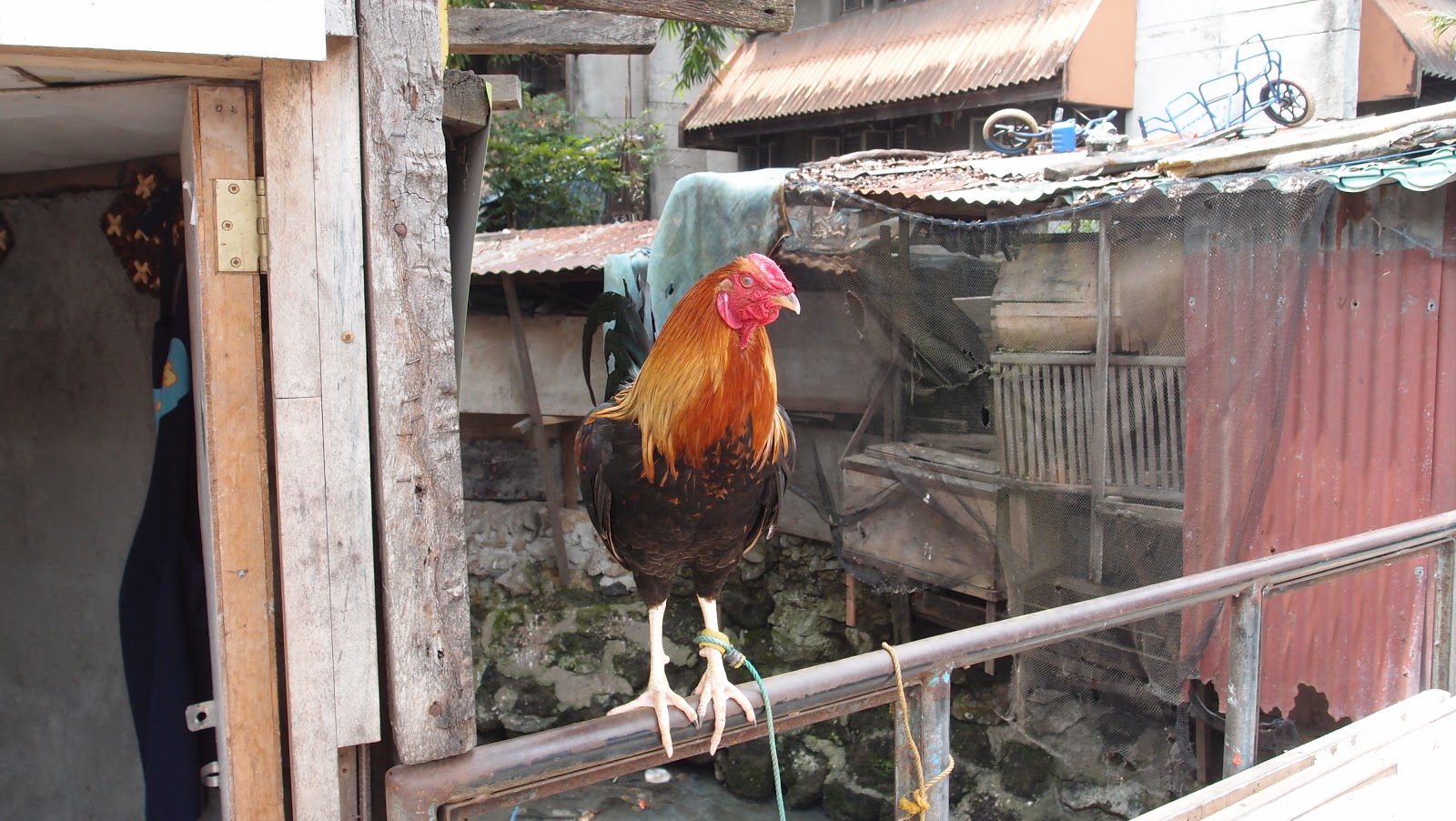
On the side of the street that receives the most shade are two wire mesh cages. Tethered to each is a handsome rooster. The black and white one is scrawny and shy. His counterpart is much more regal looking with his rich brown, black and green plumes and his slow and deliberate strutting. Both are being groomed as cock fighters.
Rooster on the bridge

The "residential area" is located adjacent to University Avenue. Houses are constructed out of corrugated tin, old pieces of plywood, tarpaulins, and other makeshift building material. There's electricity; some houses have lights, televisions, or even an imitation Play Station. It's cramped. Clothes lines stretch between roofs and trees, connecting neighbours in the daily airing of (previously) dirty laundry.
Laundry hanging out to dry

Everywhere there are children. Running. Skipping. Playing marbles. Laughing. Yelling. Shooting baskets. Carrying school books. Carrying younger children. Fetching this or that for an adult. Drinking soda from a plastic bag. Calling out to the "Americanos". Sneaking looks at the baby "doll".


Children walking to school
A small stream runs through San Vincente. It reeks of urine, garbage and rotting leaves. The stream forks somewhere between the footbridge and the shanties. Right now, there's a mere trickle of water, but whenever a typhoon rolls into Manila the trickle swells and swells and swells. It rises above all the houses, forcing residents into the safety of the second floor of the barangay hall.

San Vincente is a part of our daily lives. We hear the sounds of roosters at dawn (and every other time of day). I buy fresh buko on my way back from morning runs at UP. We stop and chat with the vendors on our way to and from the university. We bring our laundry to the laundry shop.* Someday (I hope), F or I will join the boys in a game of basketball. I chat with other young moms about their babies.

*        *         *        *

The cost of these pictures is 1,000 PhP - not because San Vincente residents demanded money in exchange for being photographed. In fact, many people excitedly asked him to take their picture. No, the fee was an unfortunate accident for F, and a lucky find for the person who found the crisp, bank-machine-ironed bill. From now on, cameras and loose bills will not share the same pocket.


* Well, everything but A's diapers, but more about our daily routine in another post.

Friday, October 7, 2011

Solar bottles light up the homes of poor Filipinos

Here's an example of a simple and inexpensive innovation that improves the quality of life of people living in impoverished conditions. Coke bottles, water and people looking for work are in ample supply in the Philippines.

Thursday, October 7, 2010

Turning trash into cash

For Buklod Tao (BT), linking livelihoods to economic opportunities is key. The activities of this community organization are based on an associative business model or “pangkilikan” in which the products of one business are purchased and used for another.

There are four businesses in the pangkilikan:  1) organic compost production, 2) organic urban container gardening, 3
) tetra pot production and 4) fiberglass mesh production. The video below outlines how the system works. 

The thoughtfulness, creativity and simplicity of the approach fascinates me. A sustainability principle is built into the system, in which sustainability spans environmental, social and economic spheres. Here are selected excerpts from my discussion with Noli Abinales (more on him and Buklod Tao in the "building disaster resilient communities" post).


On composting...


The composting business is temporarily on hold, for several reasons. First, their "shredding machine" is broken. Second, the neighbours of Buklod Tao complained about the smell and the municipality has ordered them to halt operations. (A similar situation unfolded in Guelph, Ontario several years ago.) BT is currently seeking land in a non-residential zone.

When the business is operational it works as follows.  Compost buckets are given to 30 participating families, along with instructions on composting do's and don'ts. Each weekday morning, BT-employed collectors pick up the organic waste. Back at the BT headquarters, t
he  waste is shredded, left to decompose in a closed container, and finally enriched with purchased powdered charcoal and chicken dung.
Compost bucket
The innovative part comes in with the integration of an alternative currency system that supports the local economy at the micro level. Points are allocated based on how much waste is in the bucket (full bucket=4 points, half-full bucket=2 points). The families receive tokens that can be exchanged for goods at selected sari-sari shops. For example, a bar of soap “costs” 12 tokens. The sari-sari owners can then bring the tokens to BT and exchange them for actual coins and bills. The scheme helps secure business for shop owners, many of whom are the beneficiaries of a post-Ondoy rehabilitation loan administered by BT. It's a small loan of P5,000, but it's enough for small-scale entrepreneurs to get started.  
The daughters of one sari-sari shop owner who received a rehabilitation loan.
This scheme achieves several goals: people sort their garbage; waste is diverted away from landfill sites (and from the river); families earn from their garbage; raw material is collected for composting and gardening businesses; urban poor gain jobs as compost collectors; local entrepreneurs gain customers and can repay their loans, et cetera. I'm keeping my fingers crossed that BT can acquire suitable land ASAP so the composting business resumes.


On organic urban container gardening...
BT has turned three vacant lots into three small urban gardens. Each garden employs one garden manager and several part-time gardeners. The garden I visit is roughly half the size of a basketball court. Not-yet-mature vegetable plants protected by a bamboo fence adorn the garden entrance. 
Entering an urban organic garden
Inside there are two shelters. One is nearly empty save several tetrapack containers stashed in a wheelbarrow. The other houses sacks of organic compost, charcoal dust, topsoil and chicken dung.
Wheelbarrow holding tetrapack containers. Note the roof of the shelter is also made of tetrapacks.
To make the most of their limited space, the gardens incorporate some permaculture techniques, including vertical gardening.  Six risers occupy most of the space. Each riser requires 10 square meters and can hold 110-120 tetrapacks. The wild colours of the tetra pots and the perky plants in various shades of green make for an attractive and cheery garden.
Riser with vegetable- and herb-filled tetra pots.
All kinds of herbs and vegetables are grown in the tetrapacks - basil, parsley, bitter gourd, tomatoes, okra, eggplant, greens and more. The produce is sold at a premium price. Some day, Noli muses to me, disaster-resilient communities will grow organic produce that is safety packaged in tetrapacks. The produce would make a welcome and healthy variation in relief kits.   


On tetra pot production...


In the Philippines, juice and fruit drinks are sold in tetrapacks. They are very popular, and kids will drink several every day. Unfortunately, many tetrapacks are carelessly discarded, littering sidewalks and clogging sewers and waterways. So the opportunity to turn this trash into something productive was a welcome one. 

Tetra pot production is not new, nor is it unique to the Philippines. In San Mateo, the initiative began several years ago when BT started collecting discarded tetrapacks from the streets, schools and conferences. They borrowed three sewing machines and began production. Some women were already making bags and other things from the tetrapacks pre-2007, but all their production equipment was lost with the Ondoy floodwaters.

Clean dry tetrapacks are sorted by colour before being sewn into various products.
Production begins with “Tetra pickers” (women, men, kids) who collect the tetrapacks, cut out the bottom flaps, snip off the tops, then clean and dry them. (Technology exists to reuse the discarded bits, but BT doesn’t have the equipment nor the technical know-how ... yet.) BT staff buy the tetrapacks for 25 centavos for a clean, standard-size tetrapack or 10 centavos for a smaller or subpar one (e.g. not cleaned properly). Last week, one woman traded in more than 3000 tetrapacks, earning herself P750 (a princely sum for an urban poor)!  
The sewing room and a pile of nearly-finished tetra pots.
Clean standard-size tetrapacks are sewed into a variety of items. The main product is the gardening container or "tetra pot", sold for P10 apiece to BT's gardening business. Sewers are paid by the piece. They receive P1.5 for the first 70 pieces per day, then P3 for each one after that. One older woman can sew 100 pieces per day and regularly earns P2,000 per week. Other tetrapack items include conference bags, roofs for tricycles, …
Tetrapack gardening containers or "tetra pots" are the main product of the tetrapack business.
News that BT buys tetrapacks has traveled to neighbouring barangays. During my visit a group of women living several villages away come by with bags full of tetrapacks. BT doesn't usually do any business on Sunday, but the women have had to pay for transportation and are very reluctant to return home without getting at least some money.


On fibreglass mesh production...
Fiberglass mesh is used for two products. The first is the fiberglass rescue boats used for the rescue operations. The boats are critical to the community's disaster risk reduction (DRR) strategy.  
Fibreglass rescue boats are key to disaster risk reduction strategies.
The second product is the fiberglass compost buckets, which are purchased by BT's organic compost production business. 
Fibreglass compost buckets
At this point in time, both business are still very small in scale because the products must be  patented, tested and certified before they can be sold to other buyers. In the foreseeable future, BT hopes to begin selling their products to the government and to other communities.

*   *   *
I imagine some readers are wondering how initiatives such as these associated businesses are funded. Buklod Tao receives funding from a variety of local, national and international sources. Some funders you might recognize include Christian Aid and Save the Children. 

One of the fascinating, sometimes uplifting, sometimes heart-wrenching aspects of doing research in a developing country is the opportunity to visit many project sites. In doing so, I'm putting a face, a name, a sound, a smell, a feeling, a story to many development/aid organizations. It's one thing to leaf through the glossy brochures of an organization. It's an entirely different experience to witness activities on the ground.

If you support an organization who works with partners in the Philippines, please add it to the comments below. If I visit their offices and/or project sites, I'll make a point to blog about the experience.  Salamat po!