Showing posts with label Metro Manila. Show all posts

Tuesday, November 12, 2013

Supporting Haiyan (Yolanda) survivors

I don't usually use this blog as a platform for soliciting aid, but the recent calamity in the Philippines requires me to relax my "blog rules". There are many local and international organisations that are and will be providing immediate disaster relief and medium to longer term recovery and rehabilitation aid. Please consider supporting one of these initiatives.

The letter below is a call for support from Kalikasan- People's network for the Environment, one of the Philippine NGOs that I have worked with since 2010. Kalikasan and their partner organisations do excellent work. Their extensive network and presence "on-the-ground" means they already understand the local context, customs and needs, and can reach some of the most vulnerable people quickly. When they did a similar outreach with the Typhoon Sendong survivors I worked with in CDO, the support extended beyond the short relief period into longer term advocacy, livelihoods and sustainability initiatives.


KALIKASAN PEOPLE'S NETWORK FOR THE ENVIRONMENT
26 Matulungin St. Central Dist., Diliman, Quezon City, Philippines, 1100
Tel./Fax; +63 (2) 924-8756     E-mail:  secretariat@kalikasan.net    Website: www.kalikasan.net

12 November 2013

Dear friends, allies and partners,

Our brothers and sisters in the Philippines are in urgent need of our help!

On November 8, super typhoon Yolanda (international name Haiyan) ravaged several provinces in central Philippines, with the provinces of Samar and Leyte as worst hit. Considered the strongest storm to hit the country and the world in recorded history, Yolanda decimated whole towns in a matter of hours. It left in its wake thousands of deaths which authorities fear to rise to up to 10,000 individuals as many others remain missing.

Communication and power lines are still down, while transportation is still impossible in many towns preventing relief and rescue missions. Around 620,000 people were displaced and 9.5 million individuals were affected by the super typhoon, according to Philippine government estimates.

In these trying times, let us express our solidarity with our brothers and sisters in the Philippines. BRIGADA KALIKASAN (Bayanihan ng Maka-Kalikasan para sa mga Biktima ng Disaster) appeals for your material or financial support to the survivors of Yolanda. Food (rice, canned and dried goods, coffee, milk, among others) water, and medicine (for cough, colds and diarrhea, paracetamol, antibiotic) are much needed. Sleeping materials such as mats and blankets, tents for temporary shelter and clothes are also appreciated.

For material donations, please drop them off at the BRIGADA KALIKASAN headquarters located at #26 Matulungin St., Brgy. Central, Quezon City.

For cash donations, please see details below:

Bank Account: Center for Environmental Concerns
Branch: BDO Matalino Branch (G/F J&L Bldg., Matalino St., Diliman, Quezon City)
Peso account number: 3640008876
Dollar account number: 103640033382
Bank Swift Code: BNORPHMM

BRIGADA KALIKASAN is being organized by the Center for Environmental Concerns-Philippines, Kalikasan People's Network for the Environment, Computer Professionals' Union and AGHAM-Advocates of Science and Technology for the People. For more information please contact us at +632.924.8756, email: kalikasan.pne@gmail.com.


In solidarity,

Clemente G. Bautista Jr.
National Coordinator

Tuesday, February 12, 2013

Academic publications, or Ada's first lecture

Publishing in peer-reviewed journals is a critical component of academic life. The old adage of publish or perish rings true for many university lifers. Your credibility, reputation and ability to garner scholarships, research grant money, tenure and promotions all depend, in part, having your research evaluated by your peers. There is a seemingly endless list of journals publishing research on an equally impressive array of topics. These journals are ranked in terms of their impact factor. For example, getting published in a journal like Nature or Science is akin to winning an Olympic medal. Scholars typically aim to publish in both very specialized journals read only by their peers and high impact journals with an extensive readership. In addition to publishing in peer reviewed journals, academics must also share their work orally - at conferences and workshops, guest lectures, in undergraduate and graduate courses. 

During my doctoral studies I need to buoy up the academic publication and presentation section of my curriculum vitae. This post is a brief account of one such foray.

*     *     *     *
Part I: The article

Last year, I co-authored a paper with Dr. James Ford, one of my profs at McGill University. It investigates one part of the climate migration puzzle, specifically how to provide protection for the people displaced by climate change. The following abstract summarizes the main arguments of the paper.

Climate change is expected to increase migration flows, especially from socially and environmentally vulnerable populations. These 'climate migrants' do not have any official protection under international law, which has implications for the human security of migrants. This work argues that the United Nations Framework Convention on Climate Change (UNFCCC) can and should recognize climate migrants, and is the most relevant international framework for doing so. While not legally binding, the acknowledgment of climate displacement, migration and planned relocation issues in the UNFCCC's Cancun Adaptation Framework indicates a willingness to address the issue through an adaptation lens. Herein, the paper proposes a framework for setting the institutional groundwork for recognizing climate migrants, focusing on the most vulnerable, promoting targeted research and policy agendas, and situating policies within a comprehensive strategy.

If you want to read the full article, it's available on the Environmental Research Letters (ERL) website. ERL is an open access journal, which means that you can read and download articles for free. An added perk of open access journals (to academics) is that your research is more likely to be disseminated outside the academic community. 

For a short synopsis, try reading Liz Kalaugher's article on the environmentalresearchweb.org website. This online magazine targets a non-academic audience so the writing style is much less academic and reader-friendly. 

*     *     *     *
Part II: The presentation

One of my key informants at Ateneo de Manila University kindly invited me to present this paper as part of their social sciences guest lecture series. I jumped at the opportunity. But it didn't unfold exactly as planned.

The lecture was set for Friday January 25 at 4:30 pm. As luck would have it, Frank received a text message from the MSI service center earlier that week, informing him that the long-awaited hard drive for our beleaguered laptop was finally ready for pick-up. We were in Manila for only a few days; Friday was the only available day for pick-up. Because the trek to the MSI office entails a short stint on the body-crushing MRT (Metro Rail Transit), bringing Ada was not an option. So Ada spent the day with me.

After a delicious lunch of bulalo (Filipino beef marrow soup) at Jek's Kubo (including a complimentary bowl of the broth and vegetables for "the cute baby with blue eyes"), Ada and I set off for Ateneo. We arrived early, with lots of time to peruse library resources and to photograph the outdoor art installation of quirky giant animals made of wire and coloured cans. I orated an abridged version of the presentation to a pair of giraffes.

Ada sandwiched between two giant giraffes at Ateneo de Manila University
Shortly before the scheduled start time I asked a fellow student if he'd hold the baby during the presentation. He replied that it would be his pleasure. As the lecture hall filled up, Ada started to fuss. She was getting into one of those moods, the one in which she refuses to be held by anyone except mom and papa. 

I sent a frantic text to Frank.

When I was introduced, the remarks included the usual info - name, degrees, country of origin, research interests, etc. The remarks also included some commentary about changing gender relations (in which the father takes time off work to care for the children), work-life balance, parental leave in Quebec, and conducting research with a baby. 

I walked up to the podium, notes in one hand, baby in the other. I don't remember much about the words alternately flowing and stumbling from my lips. I do remember bouncing my daughter up and down on my hip, listening to her babble into the microphone, watching her make eyes at the audience. I remember feeling mortified and guilty; the guilt comes from wondering whether or not I am exerting white privilege by bringing my baby to work and expecting others to ignore the inconvenience. I remember stealing frequent glances at the door, willing Frank to enter the room.

A half hour later he does. Waltzes down the stairs to the podium, picks up the baby and exits the room. 

My knight in shining armor is also my yaya (Filipino term for nanny).

Despite (or perhaps because of) the distraction of my co-presenter, the lecture was well-received. I am very grateful that everyone I have met here in the Philippines, without exception, has been extremely understanding and receptive to accommodating a baby. Even when it entails listening to a lecture delivered (in part) by a seven and a half month old.

Reference: Christine Gibb and James Ford (2012) Should the United Nations Framework Convention on Climate Change recognize climate migrants? Environ. Res. Lett. 7 doi: 045601

Monday, November 19, 2012

Balut

Warning: This post may not be suitable for vegetarians and for people who prefer to forget the meat on their dinner plates was actually destined to be an animal.

If you're craving a small merienda (Tagalog for snack), you may be tempted to try a Pinoy specialty: balutBalut are sold at semi-permanent roadside stalls or by roaming one-man sellers (the vendors are mostly men) who call out "baaaa-luuuuuut" in loud deep voices every few minutes. The eggs are usually carried in insulated styrofoam containers, about the size of a can of paint. Inside, the eggs are kept hot. The sellers also carry all the accouterments: salt, vinegar and chilies. Some sellers will also carry water and soap so you can wash your hands.
Balut container, chicharon snacks, salt and spiced vinegar
Balut are boiled duck embryos. On the outside, balut look just like hard-boiled eggs. To eat balut, you start by slurping up the 'soup' - the embryonic fluid. Next you peel away the eggshell until only a tiny sliver of shell remains at the bottom. Then, you sprinkle on some spiced vinegar, tilt your head back, pinch your nose and try not to think about what is coming next. Holding the sliver of eggshell, pop the embryo into your mouth and bite. You might be crunching on a beak and feathers, depending on the age of your balut. After the final swallow, you can eat a pinch of salt to slightly change the taste. Alternatively, you can add the salt at the same time as the vinegar.
Looking inside the balut
One of us (not yours truly) tried (albeit reluctantly, and with much goading from yours truly) balut. This is how the culinary adventure transpired.

After our pedicab ride, Goon asked us if we'd tried balut, then offered to have one with us. I politely decline and offer to photograph the experience instead. Frank agrees to partake in a small merienda feast. Goon buys two balut at 25 pesos apiece, then proceeds to explain and demonstrate the process. Of the experience, Frank recounts that "It just tastes like soup, like broth. It's more the texture that's different. The yolk is like biting through hard rubber."
Goon and Frank eating balut
If you're not convinced by the culinary appeal of balut, then perhaps another one of its attributes may convince you: it is a reputed aphrodisiac, and telling locals you've tried it instantly confers street cred.

Bon appétit!

Wednesday, November 14, 2012

Pedicab tour in Intramuros

One Sunday, F, A and I decide to play tourist and visit Intramuros. Our guide book (The Rough Guide to Southeast Asia on a Budget) describes Intramuros as

"the old Spanish capital of Manila [and] the one part of the metropolis where you get a real sense of history. It was built in 1571 and remains a monumental, if ruined relic of the Spanish occupation, separated from the rest of Manila by its crumbling walls. It featured well-planned streets, plazas, the Governor's Palace, fifteen churches and six monasteries as well as dozens of cannon that were used to keep natives in their place. Many buildings were destroyed in WWII but Intramuros sill lays claim to most of Manila's top tourist sights."

The use of motorized vehicles is restricted within the limits of Intramuros, so pedicabs are a popular alternative to cabs, jeepneys ad tricycles (the motorized version, not the ones small children and circus clowns ride). A pedicab is the Pinoy version of a cycle rickshaw. It's a bicycle welded onto a small covered sidecar. It seats two to three passengers comfortably, and is often used to bring passengers short distances. The pedicabs of Intramuros are all painted an olive green colour. The colour almost blends into the historical buildings, a stark contrast to the flashy designs and colours of jeepneys.

After walking around in the sun with a crying baby, we start searching for an alternative way to explore Intramuros. Pedicab drivers have been calling at us since we arrived, "Hello ma'am, hello sir ... historical pedicab tour for only [insert varying sums of pesos]?" We opt to go with Goon. Goon, pronounced 'goo-oon', is a twenty-something pedicab driver-cum-tour guide. Like many Filipinos, Goon has an excellent command of English. He's amicable and outgoing, without being pushy like some of his colleagues. His pedicab is a Mitsubishi, or so says the logo on the front. It's the only adornment that distinguishes Goon's pedicab from the others.

Goon's Mitsubishi pedicab
Goon asks F if he's an actor. He says he is "guapo" (handsome) and looks like Orlando Bloom. (F tells me later that most of the people who have called him guapo are young boys, and that he's looking forward to a member of the fairer sex to pay him that compliment.) Goon tells us that Hollywood actors come through Intramuros relatively frequently. He's taken a few in his pedicab. Most recently, he took the lead actor from the latest Bourne film, which was shot in the narrow streets of Intramuros. The actor even pedaled the pedicab for a short distance.
Street view of one of the chase scenes in the latest Bourne film
The pedicab tour includes stops at:
The Manila Cathedral was first built in 1581 (and later in 1954 and 1958 after it was destroyed by war, typhoons, earthquakes and fire). It's a popular choice for weddings. The giant tarpaulin advertises the Catholic Church's position against the proposed Reproductive Health (RH) Bill.
The ruins of Fort Santiago - former fortress of both Spanish and American colonial powers, and the site where José Rizal (Pilippine national hero) was imprisoned before his execution.
San Augustin Church
To me, the most intriguing part of the experience is Goon's commentary on life in the Philippines. For example, he asks us whether we've ever been to the USA? "Yes," we reply. He laughs, then tells us he lives in the USA, and that he's going to take us there. His USA is the "united squatters area". He makes light of the situation; it seems to be a common cultural trait to infuse humour into otherwise difficult issues. Regardless of how you frame it, the reality is that there are many "USAs" in the Metro Manila Region. The urban poor who inhabit these areas are vulnerable for many reasons; their counterparts in Cagayan de Oro (CDO) will be one of the target populations for my research. So, I pay close attention to our guide's lively chronicling of the history of Intramuros, and especially of the current residents of this USA.
Children play at the outskirts of the "USA"
The pedicab tour turns out to be a wonderful way to while away a few hours, learn about the many incarnations of Intramuros, and glean some insight into its residents, past and present. The tour ends with Goon offering F a Philippine delicacy - balut. More about that experience in another post.


Monday, October 29, 2012

Computer woes

What is your computer to you?

  • A source of amusement and distraction?
  • A repository of photos and videos?
  • A means to keep in touch with family and friends via email, Skype, Facebook, Twitter and other social media?
  • A connection to the wider world through news websites?
  • A reminder of home and familiar things?
  • A music, movie, games and podcast player?
  • A work or research tool for storing precious data?
  • An extension of your brain and a requirement to get work done?
What would you do if it died unexpectedly?

The hard drive on our two-and-a-half month old laptop is broken. It happened Friday morning, for no apparent reason.

I'd woken up early to finish the questionnaire for my interviews and the guidelines for the participatory video component of my field research. I'd spent several hours working and reworking them on Thursday. I wanted to bring polished copies to my colleagues at the Third World Studies Center at the University of the Philippines-Diliman, where I am a visiting research fellow.

The laptop turns on, but won't go past the initial black screen with the white writing in the font all computers seemed to use in the 1980s.

F, infinitely more tech-savvy than me, patiently tried every trick he knows to fix the problem. No dice. He's heavily invested in the functioning of the laptop too. To him, it's a connection to home and Canadian life: months worth of video games to play while I'm off conducting interviews, internet-based "geek news" to read, Quirks and Quarks podcasts to listen to while cooking supper, ... In other words, it's a tool for dealing with homesickness, and a means for mitigating culture shock.

F spends Friday traipsing around Quezon City seeking a computer fix. At Philcoa, he alights a jeepney headed for the SM North mall. It has a specialty MSI store (our laptop brand). A traffic cop stops the jeepney. The stop is long enough for F to look back and notice a computer repair shop on the second floor of Philcoa. He disembarks and walks back. He drops the laptop off at the computer repair shop, leaving specific instructions to not format it. Three hours later, he receives a text message asking if the laptop is under warranty. F returns to Philcoa, and declines the offer to physically open the laptop, extract data from the hard drive, thereby voiding the warranty. F hops on another jeepney heading for SM North. The MSI store staff can't do anything except direct him to the MSI service center, which, being October 26th and a holiday, is closed.

On Monday, F continues on his quest. It starts with a chaotic and crushing trip on the MRT (Manila's equivalent of the metro/subway system). The service center consists of three desks. The only staff present tells F that it'll take at least 30 to 45 business days for them to do anything because it's an international warranty, because parts need to be shipped in from Taiwan ... the list goes on. 

*       *       *       *       *

Luckily, we backed up our photos and my research material a few days before "the crash". All F's games and our music and podcasts are gone, as are all of the programs installed on the laptop. 

It is proving to be a frustrating experience, and also one that forces us to think about the central role our computer plays in our lives. It changes the way we think, keep informed and connected, interact with others, keep in touch from afar, and be entertained. The experience is also forcing me to plan out my research with pen and paper - a practice that seems so foreign to me. Depending on how the repairs unfold (or not) will change - to an extent - what I'd planned to do (or how much I planned to spend on replacement equipment).  

Flexibility and a sense of humour... two of the greatest assets a field researcher can possess.

Monday, October 22, 2012

A photo shoot in San Vincente

San Vincente is the second slum F has ever set foot in. The first was a short walk away from his resort in Venezuela. In the market there, you could score a bargain on a Poly Station. Not sure if it was compatible with Play Station games though. On one of his first days in the Philippines, F took photographs San Vincente.
The entrance gate to San Vincente
In politically correct terms, San Vincente is an "informal urban settlement". It's a lively hub of activity a block and a half from our current home in UP Village. Vendors hawk their wares and street food. Small sari-sari shops line the main road selling everything from rice, sachets of Datu vinegar, fresh fish and buko (fresh coconut) to hair clips, cell phone covers and secondhand clothes. Haircuts at the barber are a mere 50 pesos (PhP); pedicures will cost you slightly more. There's a laundry shop where the women will wash, dry and fold your clothes for 25 PhP a kilo.
Sari-sari shop

Just outside the gate separating San Vincente from UP Village, tricycle drivers sneak in catnaps between ferrying customers along Maginhawa Street to Philcoa. The drivers are mostly young men and very friendly. Some blare music from old radios, probably scrounged from recycled parts. The stench of dirty diesel 2-stroke engines wafts through the air.

Tricycle drivers
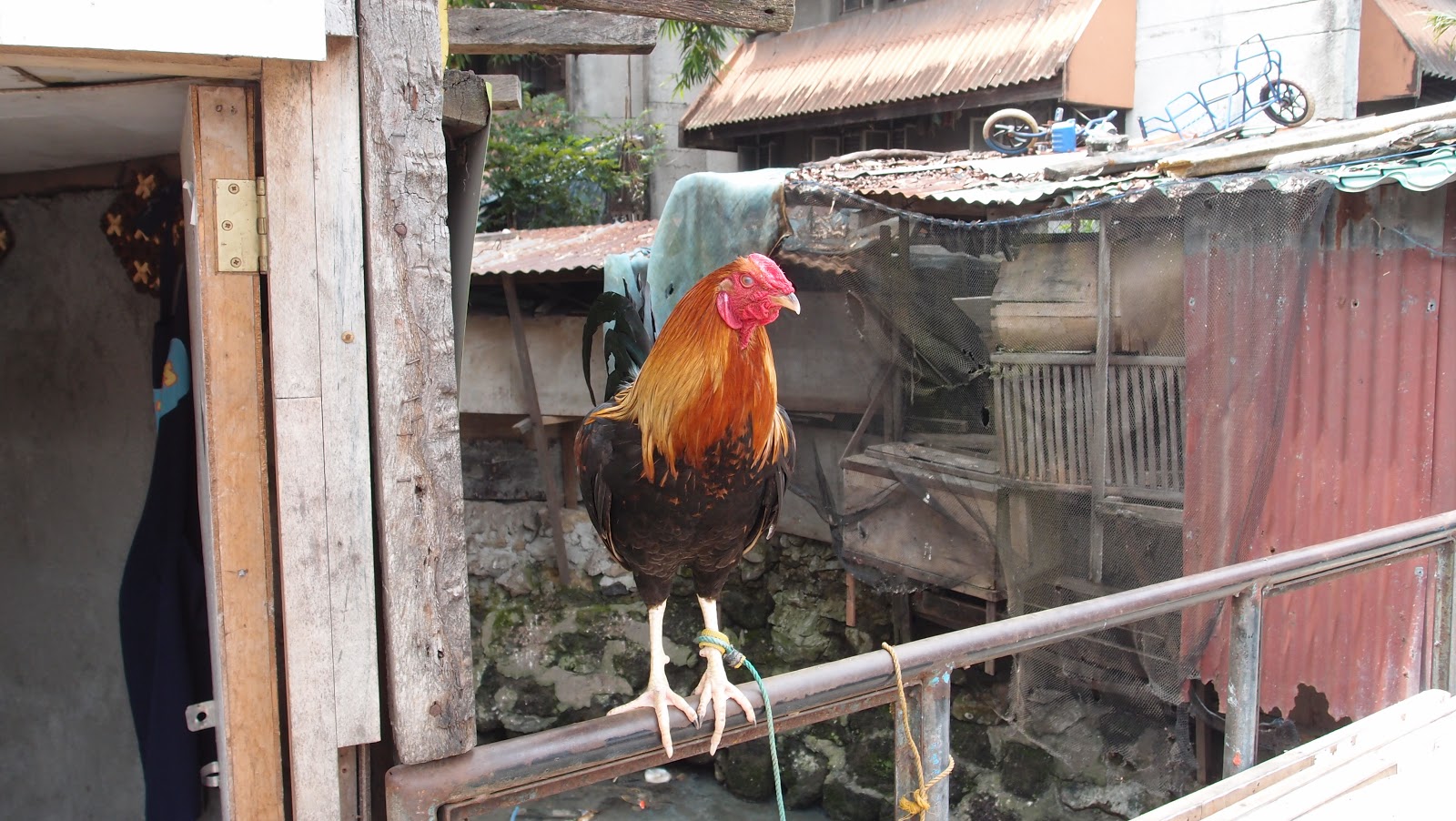
On the side of the street that receives the most shade are two wire mesh cages. Tethered to each is a handsome rooster. The black and white one is scrawny and shy. His counterpart is much more regal looking with his rich brown, black and green plumes and his slow and deliberate strutting. Both are being groomed as cock fighters.
Rooster on the bridge

The "residential area" is located adjacent to University Avenue. Houses are constructed out of corrugated tin, old pieces of plywood, tarpaulins, and other makeshift building material. There's electricity; some houses have lights, televisions, or even an imitation Play Station. It's cramped. Clothes lines stretch between roofs and trees, connecting neighbours in the daily airing of (previously) dirty laundry.
Laundry hanging out to dry

Everywhere there are children. Running. Skipping. Playing marbles. Laughing. Yelling. Shooting baskets. Carrying school books. Carrying younger children. Fetching this or that for an adult. Drinking soda from a plastic bag. Calling out to the "Americanos". Sneaking looks at the baby "doll".


Children walking to school
A small stream runs through San Vincente. It reeks of urine, garbage and rotting leaves. The stream forks somewhere between the footbridge and the shanties. Right now, there's a mere trickle of water, but whenever a typhoon rolls into Manila the trickle swells and swells and swells. It rises above all the houses, forcing residents into the safety of the second floor of the barangay hall.

San Vincente is a part of our daily lives. We hear the sounds of roosters at dawn (and every other time of day). I buy fresh buko on my way back from morning runs at UP. We stop and chat with the vendors on our way to and from the university. We bring our laundry to the laundry shop.* Someday (I hope), F or I will join the boys in a game of basketball. I chat with other young moms about their babies.

*        *         *        *

The cost of these pictures is 1,000 PhP - not because San Vincente residents demanded money in exchange for being photographed. In fact, many people excitedly asked him to take their picture. No, the fee was an unfortunate accident for F, and a lucky find for the person who found the crisp, bank-machine-ironed bill. From now on, cameras and loose bills will not share the same pocket.


* Well, everything but A's diapers, but more about our daily routine in another post.

Wednesday, October 17, 2012

The fourth “M”


This blog chronicles the journey (and tangents) of my PhD.

It begins in Montreal, where I am a student in the Université de Montréal’s geography department. Almost immediately it jumps to a tiny street in Quezon City called Mayumi. Mayumi was my home base for my three month exploratory field season in the Philippines in 2010. Then, it returns to Montreal for coursework and comprehensive assessments (neither of which receive much space on these pages). The third “M” refers to an intensive two-month Tagalog (Filipino) language course in Madison, Wisconsin.

Thus we arrive at the fourth “M”: motherhood.

On many occasions, I have been told that there is never a “good time” to have kids. This is particularly true for academics – not as an undergraduate or graduate student (time and financial constraints), not as a post-doc (similar constraints as students), not as a young prof trying to balance a research programme, teaching requirements and administrative duties. The gap in publications that often accompanies parental leave isn’t always looked upon favourably in tenure applications.

And so, for someone (hopefully) headed on a professorial track, the question is not when to have a family but rather how to make it work.

*             *             *             *

Four months ago my husband and I became parents. Thus far, it has been an exhilarating experience.

Motherhood is also changing various dimensions of my PhD, in particular the dynamics of my field research. In this field season, for example, I’m joined by my husband and daughter. While they won’t accompany me to every meeting, interview and event, they will be integral parts of the research process. I anticipate that I will be treated differently, and perhaps privy to different kinds of insights, when people see me as a mother, in addition to being a western woman researcher. Caring for an infant also means that the pace of research is slowed. Plus, it's more challenging to act spontaneously and chase down leads at a moment's notice. 

On a personal level, I'm thrilled to share the highs and lows of new experiences with loved ones in person, and not just via Skype, email and blogs. 

*             *             *             *

And so I enter my main field season with fresh eyes and ears, attuned not only to things relevant to my research project, but also to things relevant to family life.

I invite you to follow along, and to comment on things that intrigue, surprise or provoke you.

Tuesday, December 7, 2010

3:22:01

Like the snowflakes currently gracing the Montreal skyline, no two marathons are exactly the same. The Second Quezon City International Marathon (QCIM) was my third marathon (the first two were Road2Hope (Hamilton, ON 2007) and Boston (2009)). It wasn't a PB (personal best), but I'm happy with my race.

Here are some thoughts on what made this latest marathon experience unique.
  
*     *     *
Wake up in the threes. The alarm clock is set for 3:15am. My internal alarm goes off a few minutes before. It must be nerves. I'm glad everything was laid out the night before: number pinned onto my shirt, timing chip secured in my left shoelace, semi-clean shorts, sports bra and socks (the pair the RnJ Laundry staff managed to find after they found out how much running socks cost) neatly folded in a pile at the foot of the bed near the gels and a small water bottle.

I stumble downstairs in the dark. Flip the switch to open the gas line on the stove. Boil water for the breakfast of champions: porridge and half a mango. It sticks to my stomach. Feels heavy, too heavy for a 3:20am meal.  But not eating would feel worse ... in the race.

By 3:45, I'm out of the house. The gate key is tied to my right shoelace. The rest of my keys are hooked on the clothesline. I jog slowly to Quezon Memorial Circle, following the "open gate" route I'd scouted out earlier. (My place is in a semi-gated community. The gates are locked from 10pm to 5am. Had I taken my usual route that passes through locked gates I would miss the start of the race.)

Quezon Memorial Circle is aglow with Christmas lights. It's beautiful.

Hundreds of runners have already gathered at the designated muster point. Some stretch or jog in place. Others fiddle with race numbers, iPods and shoelaces. The queue for the port-o-potties grows by the minute.

A taho vendor walks through the crowd, hoping for some sales of this favourite Filipino snack. There aren't many takers.

It's still dark as the runners shuffle to the start line. It's on Commonwealth Avenue, right before the Philcoa overpass. When I first arrived in the Philippines, a good friend told me that the Philippine Coconut Authority (more commonly known as Philcoa) was the centre of the universe. In a sense, he's right. Informal vendors hawk wares of all shapes and sizes on the sidewalk. There are medical facilities, internet cafés, fast food joints, cell phone repair shops and banks. There are jeepneys, buses, taxis and tricycles available for hire. It's the Quezon City gateway to the rest of the world.

The race begins in the usual Filipino fashion. Local media personalities pump up the crowd. A municipal official delivers a speech. Someone prays, asking God to bless the runners, the race organizers, the fans, etc. A fitness club rep leads some warm-up stretches.

After much hoopla, the start gun is fired.

The beginning of the route is familiar, snaking along the roads I frequent on foot and by jeepney. It feels odd to run along Commonwealth Avenue, a heavily trafficked area nearly 24/7. One side of the divided highway is closed to traffic (well, mostly). Traffic on the other side is gridlocked. Drivers and passengers shoot dirty looks at us runners, silently cursing us for causing more traffic than usual.
The gazelles passed me at kilometer 16. Well, the ones running the half marathon. The gazelles in the 42.195 km race were ahead of me even before the starting gun went off.

I run the first half in the company of two Filipino men I nicknamed "Red shirt" and "Black shirt." We push each other, alternately taking the lead and draughting in each other's slipstream. We attract a lot of cheers from onlookers. The cheering is in English.

Black shirt and I pull away from Red shirt shortly before Marlboro Street. We run the first half in 1:35:00. (I don't have a watch and only found out the splits after the race.) It feels good, but I'm not sure I can sustain the pace for the full race. 

Corey Hart's "Sunglasses at night" is stuck on repeat in my head. I'd decided to wear a cap and sunglasses for the race. The sun is up when I reach the halfway point. My internal music player finally moves to another song. 

The kilometers through the Mesa Dam are the most scenic parts of the course. My legs feel lighter and turn over quickly. I take big gulps of soot-free air. My internal camera snaps pictures of the lake, the trees, the winding road, the gardens. While the hills are a welcome break from the otherwise flat course, my legs quickly grow tired. The near-absence of hill training is showing.  

Black shirt starts to tire at the turnaround point. I start the second half alone, then play cat and mouse with some runners in front of me. Runners en-route to the mid-way point offer encouraging words as our paths cross.

Back on Commonwealth Avenue, the crowd has grown. More spectators, more vendors, more jeepneys, more taxis, more tricycles. By kilometer 25, the crowd of runners swells. The marathon runners are joined runners in the shorter distances. Navigating through runner-traffic is not unlike weaving in and out of vehicle traffic.

I'm slowing down, but I don't have any kick left in me. I've had both my gels. I'm counting down the remaining distance in "UP laps." My head and legs know what they feel with five, four, three, two, one more lap to go.  The actual lap around the academic oval feels great. As I exit the campus, I tell myself that I'm starting the penultimate lap. It's a comforting thought.

On Garcia, I hear a familiar voice. "Go Chris!" It's the laundry lady from RnJ Laundry. I'm delighted she's come out to watch the race.

With a kilometer left to go, onlookers are cheering wildly. Everyone seems to be yelling "only 200 meters left" - it's a looooong 200m. It's a relief to finally cross the finish line.
QCIM 2010 Medal
Finisher's medal
*     *     *
Some finishing thoughts

The race wasn't particularly fast, at least by international standards. 
It could be because of the heat, the pollution, the humidity, the hills or any combination of these factors.The first male and female finishers run the race in 2:22:48 and 2:54:00, respectively. (The world records for the marathon are 2:03:59 - Haile Gebrselassie and 2:15:25 - Paula Radcliffe.) 

Post-race people-watching is a snapshot of life in Quezon City. ~ Sandwiched between the post-race water kiosk and the Powerade kiosk is a vendor. He's selling cigarettes. In fifteen minutes, he makes a grand total of zero sales. ~ 
Street children mill around the finishing line. They collect empty plastic bottles. I give my unopened bottle of Powerade to a young girl. ~ Random runners approach me, inquiring if I am "the woman who runs at UP." They ask to have their picture taken with me. I happily oblige, and wonder what they will do with a photo of them with a sweat-drenched foreigner.  


Zorro is at the awards ceremony, decked out in full Zorro regalia. Unfortunately, he wasn't able to make it out to the UP campus for the race. He cheers loudly as the winners are announced, making up for his earlier absence. I say my good-byes.

*     *     *
My race by the numbers

  • 3:22:13 (gun time); 3:22:01 (chip time)
  • 31st overall (out of 526)
  • 9th female (out of 48) or 3rd, excluding the Kenyans (aka gazelles) 


*     *     *
QCIM links

Race photos
Race results
Kenyans run show in Quezon City International Marathon (Philippine Star)

Kenyans dominate QC International Marathon (GMANews.tv)


♪♫♪ It's a small world after all ♫♪♫

Have you ever traveled, told someone you were from Canada and had them respond: 

"Oh, I met [insert random first name] from Canada. I think (s)he lives in [insert Canadian city]. Do you know him/her?

You smile, then shake your head with regret. You explain that there are 33 million people in Canada and that your home city is actually several hundred kilometers away from their friend's city. 

On rare occasions, however, you discover a connection.

It's thrilling. It's satisfying. It rekindles memories. It takes you back in time to another part of your life.

*     *     *  

In 2004-2005 I was an intern with Honey Care Africa in Nairobi, Kenya. One of the highlights was "running with the Kenyans" (or more precisely, running in their dust). 

For several months, I trained with Sam. On weekdays, we'd meet at 6:00am in the Nairobi Arboretum. The Arboretum was a short mile or so from Kat and my apartment in Westlands; Sam's place was 10km away. We'd run a workout together. He'd pace me through intervals, fartleks, easy runs, hill runs, etc. On the occasional weekend we'd do a long run, a special hill workout or a training session at the airport. He'd give me running tips about clothing (the Kenyans have known about the benefits of compression workout and recovery attire long before compression gear surfaced in North American running stores), nutrition, sleep, etc.

My workouts with Sam were the "easy" part of his training regime. I think he enjoyed the challenge of teaching a "mzungu" (white person) how to run. After our morning sessions, he would run home (another 10km), rest a few hours, then do his "real" workout. 

Sam can run a sub-60 half-marathon. That's fast. Really fast. The world record is 58:23.

*     *     *  

After finishing the marathon I wander around Quezon Memorial Circle, sample running nutrition products, enjoy a short post-race massage. Near the stage, a live band entertains a large crowd of families. It's only 8:30am. 

A group of African runners sits at the base of a small monument. They look cool and refreshed, having already changed out of their racing singlets and shorts. They don't look tired. I'm in awe. African runners are to me what Maurice Richard, Wayne Gretzy and Sidney Crosby are to Canadian boys.

Like at every race, I scan the faces, hoping for a familiar one. No luck.

I approach the group. After exchanging pleasantries and politely asking about their races, I inquire if any of them are Kenyans. Everyone nods.  

Then I pop the question.

"Do you know Sam from Nanyuki? He trains at the airport in Nairobi and does workouts at the big hill. The one where you can see zebras and giraffes - it's about a 45 minute matatu ride from the Nairobi Arboretum."

It's a long shot. There are 39+ million Kenyans. Still, the circle of elite runners can't be that big. 

There's a pause, then a young man nods. 

"Yes, I know Sammy."

We swap stories. He tells me that he's from Nanyuki. He trains both in Nanyuki (to reap the benefits of high altitude training) and in Nairobi. He does workouts at the airport and the hill outside Nairobi. He runs with Sam.

Before parting ways, he takes my hastily scribbled note and agrees to deliver it to Sam.

On the walk home, I marvel at how small the world is. 

*     *     *

I'm looking forward to trying the workouts my new friend promises to send. And I'm especially looking forward to testing them with my running partner back in Montreal.

Thursday, December 2, 2010

Three sleeps

Only three short nights left until the big day. The butterflies are already fluttering about in my stomach.

My training has shifted into taper mode, the pre-race period one to two weeks before a major competition in which you lay off the hard training so that your body is well-rested.  With the reduced mileage comes (slightly) more time for writing.

*      *      *
As many a long distance runner will attest, training has its ups and downs (figuratively, and in ideal training conditions, literally too). Training in a tropical country while doing fieldwork poses its own suite of challenges. Here are some training highlights and hiccups.

*      *      *
Workouts
Training for a marathon often entails following a plan with a variety of workouts – tempo runs, hills, intervals, recovery runs, LSDs, cross-training and rest. Some runners (present company included) are neurotic about designing the ideal program, calculating target pacing, completing all workouts and meticulously recording everything in a training log.

My current training regime, however, is very unstructured. The terrain, the climate, the research, the pollution, the travel and the availability of cross-training activities all affect what I can and cannot do.

LSD Runs
Long slow distance runs are a key component of any training program, especially for the marathon. I usually look forward to them as they offer opportunities for exploring new places or long chats with running partners. In Quezon City, there’s really only one place to escape pollution and traffic for effective LSDs: UP Diliman.

The academic oval at UP Diliman campus

I run laps around the academic oval. Running laps makes it easy to track mileage and avoid carrying fuel. Running laps can also be repetitive and boring. I change direction every couple of laps to ‘spice things up.’ I change my stride to match the song playing on my iPod. There are ~1000 songs on the iPod but I usually listen to the same playlist on LSDs. Here’s a sample of the songs and their elicited response.

ABBA (various) … warm-up
Avril Lavigne (various) … picking-up-the-pace … flashback to counting bird blood parasites in my undergrad
The Buggles (Video killed the radio star) … head bobbing … flashback to recovery runs with the Queen’s x-country team  
Paul Simon (various) … lip sync
Moby (Bodyrock) … flashback to surfing (à la kayak) on Big Joe … press repeat 2-3 times to extend the exhilaration
Shakira (various) … dancing on the run
The White Stripes (My doorbell)… light steps

The penultimate long run (in training) was last Tuesday.

Eighteen laps.
Eighteen long laps.
Made especially long because my iPod batteries died.

It was only when I was leafing through my housemate’s copy of “Runner’s World Philippines” that I learned that the academic oval is 2.2km and not 2km. So with the warm up, I had run a marathon.

Only two LSDs were done somewhere other than the academic oval. One in Nagoya, Japan. One in Legaspi, Philippines. While the weather was cooler in the former and made for better running, I preferred running in the latter. Picture running next to the sea in the wee hours of the morning. In the distance is Mount Mayon, a near-perfect conical active volcano and the pride and joy of Legaspi.

*      *      *
Fueling 
My preferred food during LSDs is dried mango. Dried mango is cheap (especially compared to gels which are twice the price as those sold in Canada). It is readily available at grocery stores. It is easy to stash in the bushes (so that I don't have to carry it on me throughout the run). I keep a few bags of dried mango in the freezer - away from the mice and geckos that manage to chew their way through just about all food packages.

Staying hydrated is critical for training in the heat. Most sports drinks make me gag; they are either too sweet or taste articificial. My first race here was sponsored by Pocari Sweat, which turns out to be palatable and effective. Since then, the drink has been my liquid fuel of choice.

I've discovered that fresh buko juice after a long run does wonders for speeding up recovery. It's cool, refreshing, filled with nutrients, and somehow reduces soreness the following day. It has become part of my routine to stop in the barangay of San Vincente on the jog back home. The young buko seller carefully splits open a young coconut, drains the juice into a plastic bag and finally scoops out the flesh. If it’s not too hot outside I save it for after my shower. If it’s unbearably hot, I drink up immediately.

*      *      *
Yoga
The Ananda Márga Yoga Centre in Sikatuna Village is a 25 minute walk or a 25 peso tricycle ride from my place. When in Metro Manila, I do an hour and a half yoga session once or twice a week. The classes are probably the reason why I have, knock on wood, remained relatively healthy and injury-free these past few months. I’m counting on the yoga sessions this week to help my legs recover from last weekend’s spelunking expedition. (It wasn’t such a great idea training-wise but exploring the Calbiga Caves in Samar was too good an opportunity to pass up.)

*      *      *
Socks
Runners don’t make for good foot models. Their heels and toes are calloused and blistered. Their toenails are either missing or purple.

The right pair of running socks can make a big difference in minimizing the damage. Knowing my feet, I brought two pairs of running socks with me from Canada. As of this morning, one half of each pair of socks has disappeared at the laundry. Unfortunately my two pairs of socks are different thicknesses so they can’t be used as a pair. And so, tomorrow I must venture into the malls in search of a new pair of running socks.

*      *      *
Zorro
Zorro is a fixture on UP Diliman campus. No one knows his real name or story. I am told that once upon a time he was a brilliant student studying physics and mathematics at the university. Then something happened. He dropped out of school. He began sporting his now-famous costume - a Zorro mask and cape - and spending his days encouraging joggers exercising around the UP academic oval. Every lap Zorro flashes a giant grin and high fives me. He usually says something along the lines of "you run fast beautiful lady." My face is already flushed from the heat and the exercise, and hides my embarrassment. Zorro told me he’ll be there for the marathon and will for cheer me.

*      *      *
The countdown to the Second Quezon City International Marathon has begun. Three sleeps, two easy runs, one jaunt to a running store ‘til the start gun fires at 4:30am on Sunday.

Wednesday, October 27, 2010

A rainy day in pictures

My second purchase after arriving in the Philippines was a bright yellow umbrella. Like many Filipina women, most of the time I use it as a parasol to shade myself from the hot hot sun.

Today, the umbrella was put to its intended use. As you'll see from the pictures below, trying to stay dry with nothing but an umbrella in such rains is akin to plugging a crack in a dam with a pebble. These pictures were taken in the higher parts of Quezon City and don't quite capture the intensity of the rains.


Young boys embrace the rain at Philcoa (the Philippines Coconut Authority, aka the centre of the universe)
Engine-powered tricycle drivers waiting for customers

Human-powered tricycle drivers wait for passengers
Motorcycle drivers cheerfully wait out the downpour under the overpass
Business is brisk for this umbrella vendor
Jeepneys and buses are reluctant amphibious vehicles

A crowd gathers at the mall entrance waiting for the rains to let up

* * *
My first purchase was a mobile phone.