Sunday, January 6, 2013

Postcards from Camiguin

A one week break from all research activities on a beautiful volcanic island in Northern Mindanao.

December 21
Greetings from Kingfisher Cottage in barangay Agoho!

After an exhaustive day of traveling, we are settling in nicely at our new abode. We had an early start to the day - with the intention of arriving in Camiguin early to mid afternoon. Our plans, however, were thwarted by:
a) an uncanny absence of taxis looking for passengers to drive into the city,
b) traffic entering CDO,
c) a long line-up of passengers waiting to alight the CDO-Balingoan bus (which worked in our favour by giving us time to use the bus station's CR (comfort room) - the cleanest public bathrooms I have ever seen in the Philippines), d) traffic leaving CDO,
e) construction on the national highway,
f) an hour delay in the ferry departure, and
g) an aging ferry whose running time, we are told, has increased steadily from one hour to two hours in the past few years.
We were glad to have asked Ralph, one half of the German-Filipino couple who own the cottage, to pick us up at the Benoni wharf.
Our first glimpse of a mist-covered Camiguin Island from the Baligoan-Benoni ferry.
On the way, we stop at the "one decent grocery store" to pick up some supplies in the capital town of Mambajao. There's a small combined wet (fish and meats) and dry (vegetables, fruits and rice) market across the road. We buy a few bags of pre-cut mixed vegetables for a stir-fry (at ten pisos a bag, it's a steal), some potatoes and a few skewers of barbecued pork (10PhP), fresh tuna (25PhP) and a fish whose name escapes me (30PhP). Masarap (delicious)!

Iggy
Daylight was fast fading by the time we left the ferry terminal. The beauty and charm of the island remains a secret ... at least until tomorrow.

P.S. Frank noticed two lizards perched atop the ceiling beam over the kitchenette. We named the larger one 'Iggy' and the smaller one 'Pop'. We enjoyed (and will continue to enjoy every night of our stay in Camiguin) watching them clamour after moths. They appeared to enjoy watching us too, and perhaps even amused when we try to engage them in conversation.


December 22
Maayong odto (good noontime) from Mambajao.

Today's the day for wandering the streets of the capital city, sampling local fare and strolling along the beach. The carabao (water buffalo) in the rice paddies along the beach fascinate Frank. The picture below is one he snapped from the beach looking up towards one of the island's majestic volcanoes, Mount Hibok-Hibok.


December 23
Today we experienced the world from a whole new perspective ... underwater. There's a beach resort / dive centre called Camiguin Action Geckos just down the hill from our cottage. It offers introductory SCUBA courses; your first dive is at one of the island's incredible coral reefs. After watching an educational video (that was probably made in the eighties or early nineties judging from the hairstyles), we hopped in a jeepney and headed to the Catarman dive site on the southwest side of the island. Exploring the reef is like jumping into a BBC nature special - except you get the full sensory experience, complete with the taste of salt water when your respirator escapes your mouth. Fish and coral of every imaginable shape and size, and more colourful than a painter's palette.

A roadside carinderia lunch included a delicious monggo bean and cabbage soup. The woman who sold it to us generously shared the recipe. (We're planning on trying it when we get back to CDO.)

In the afternoon, Frank had his turn underwater. He explored a reef just off White Island, near Action Geckos. Among the marine life he saw were two sea snakes and the silhouette of a sea turtle.


December 24
Joyeux Noel!

It's raining (again). It's amazing how the weather is so different from Cagayan de Oro City, less than one hundred kilometers away. CDO has not had a single full day of rain since we arrived mid November, while we have not yet experienced a sunny day in Camiguin.

A rainy day is a great day for visiting one of the island's waterfalls. We opt for the highest ones: Katibawasan Falls. It's a 75m drop. We charter a motorella for a 'special trip'. The lack of good maps and street signs means that you're less likely to get lost if you ride public transit than if you venture out on your own with the tourist map.

The young boy riding shotgun in the motorella wore an Armani t-shirt. His father, the driver, probably makes less than 200PhP a day. Armani clothes are probably sold for bargain prices at the town ukay-ukay (used clothing market).

At the falls, there is a group of physiotherapy students from South Korea. They are volunteering in CDO. They tell us the water is cold, but wonderful for a swim. The water is definitely colder than what we've grown accustomed to here in the Philippines, but infinitely warmer than the Quebec rivers we kayak in early spring.

One of several pools at Ardent Hot Springs
We spend the latter part of the afternoon relaxing in the warm soothing pools of Ardent Hot Springs. The natural pools are warmed in the neighbouring Mount Hibok-Hibok volcano. If you concentrate, you can smell a faint whiff of sulphur, but it's not the overpowering stench of rotten eggs. There are a series of beautiful little pools and waterfalls the same temperature as a baby's bathwater. Ada revels in this gigantic bathtub.

P.S. Tonight was Frank's night for handwashing diapers. Daily diaper washing has become a necessity because it takes so long for the diapers to dry in such a wet and humid climate. Before going to bed, Frank jokes that he never imagined that his first Christmas Eve in a tropical paradise would include such a dirty job.

December 25
Merry Christmas from Kingfisher Cottage! 

It's another rainy day so we've opted for a leisurely day.  Breakfast is French toast (the preferred breakfast of dads-on-parental-leave), fresh pineapple and mango, and instant coffee. After eating, we opened a few gifts while listening to the Puppini Sisters Christmas album. Ada's favourite present was the box.


The cottage owners, Ralph and Suzie, invited us to a Christmas lunch buffet. Like other family-based gatherings in the Philippines, there were copious amounts of food.  We spent several hours eating and conversing with a dozen or so guests. We had a particularly interesting discussion with a Camiguin-based couple, a Swiss man married to a Filipina woman, about grandfather aged foreign men starting a second family with a several decades younger Filipina woman.

I managed to sneak in a short run up to Ardent Hot Springs then down to Action Geckos before dinner. It was raining, so it felt like a late spring run in Montreal ... except for the coconut trees, roosters and pigs.

View of White Island from Kingfisher Cottage

December 26
Kamusta ka!

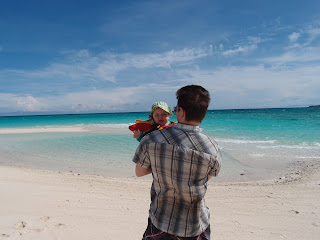
Despite soaring temperatures, we enjoyed a white Christmas. We spent late morning and early afternoon (with the time difference, this morning can be considered December 25 in Canada) on White Island, a gorgeous white sand island about a kilometer from the coast.

We shared a bangka (boat) from the mainland to the island with a newly-married couple on their honeymoon. He's from Ottawa, working in Calgary (and he's a Habs fan); she's from CDO, working in Calgary.


Frank and I took turns swimming with Ada in a shallow pool, and snorkeling around the reef. It was absolutely stunning, and we failed to notice how strong the sun had become. Only the baby, in her full-body UV suit and Australian lifeguard-inspired hat managed to escape sunburn.
Lesson learned!


December 27
Have you ever wondered about giant clams? They are perhaps one of the most awe-inspiring life forms.

Our visit to Cantaan Kabila White Beach Giant Clam Sanctuary was the most amazing day of the trip. Six of the nine species of giant clams found worldwide are raised here. The small entry fee pays for the maintenance of the centre and its research activities, and provides a source of livelihood for locals. It's more profitable for locals to maintain this biodiverse gem as an ecotourism destination than to harvest its marine life to sell at the market.

A visit begins with a short introductory biology lesson on the life history of the clams, and is followed by a tour of several aquariums with giant clams and fresh water tilapia. After, a local guide takes visitors on a "snorkel tour" of the giant clam sanctuary and reef. Even though the reef was partially destroyed by Typhoon Pablo, it still boasts some of the best snorkeling on Camiguin. You have to be especially careful where you step because the force of a giant bivalve slamming shut can easily sever a limb.

After snorkeling, we ate the best and probably freshest meal we've had: calamari, grilled emperor fish and Filipino-style chop suey (vegetables). The sanctuary maintains a fish pen where they raise fish for their restaurant. They catch a few fish or squid each day to transform into gourmet meals for hungry snorkelers.

December 28
Sniff, sniff. It's time to leave this tropical paradise and head back 'home' to Cagayan de Oro City. We're excited to see our CDO family again, but will miss adventuring in Camiguin.

Sunday, December 30, 2012

Liquid gold

After Typhoon Pablo, there's an outpouring of support to the affected areas. Donations range from noodles, water and canned sardines to blankets, clothes, cash and medicines. And chain saws - to cut all the felled trees so that the lumber can be sold or used for rebuilding.

A young twenty-something mother and a few of her friends opt to collect another sort of relief good. These first-time mothers created an awareness and advocacy group in November to educate themselves and others about baby-wearing, cloth diapers (the enthusiasm for porte-bébés and couches lavables in la belle province has not yet spread throughout the Philippines), breast feeding and related baby matters. A natural extension of their education project is a milk letting drive.

At a milk letting drive, nursing mothers pump and donate breast milk. The set-up is similar to a blood drive:  preliminary medical screening, semi-private areas for mothers to pump milk, medical professionals who seal the collected milk in sterile milk bags, post-donation water or juice for donors. The intended recipients for this particular milk letting drive are the orphans of Typhoon Pablo in the eastern parts of Mindanao.
The organizers with their babies

The group's founder is Nadine. She's a confident, poised and educated woman. When she talks about breastfeeding, her face lights up and her voice becomes animated, drawing in the listener. She wants to pursue her passion as a professional and become a certified lactation consultant. Unfortunately, there are no such certification options available locally in CDO.

Three days after Pablo struck the Philippines, Nadine contacted the management at the Ayala Centrio Mall, the newest and trendiest of CDO's malls. They were receptive to the idea of allocating some space for the collection of this 'liquid gold for Typhoon Pablo orphans' and agreed to waive the usual exhibitor rental fee. The group is still responsible for paying for security and janitorial services.
Pay it forward CDO
Liquid gold for Typhoon Pablo orphans
(A milk letting drive)
Convincing middle class mothers at the mall to pump and donate a few ounces of breast milk is an arduous task. Nadine explains that breastfeeding is not strongly encouraged at the hospitals. Moreover, the prevalent attitude is that, for those families who can afford it, commercial formula is a desirable and maybe even preferable baby food choice. Of the nursing mothers she encounters at the mall, many decline to donate for fear they won't have enough milk for their babies. A possible, but unlikely situation.

It's a different story among women whom Nadine refers to as "marginalized". These women breastfeed. They don't need to be convinced of the benefits of nursing for mother and child. They nurse out of necessity. They nurse at home, at work, on jeepneys and non-air con buses, in churches, in carinderias (small cafeteria style eateries), in covered courts, in barangay halls, in wet and dry markets, outside roadside shops. But these women aren't at the mall.

At the end of the three day milk letting drive, Pay it forward CDO has netted just over three litres of milk and has raised an immeasurable amount of awareness. Given the limited number of eligible donors, the mall crowd's reticence to nurse and donate milk, and the minimal amount of event promotion, this is a remarkable achievement.

A laudable goal and effort by a caring group of young middle class mothers. Still, I can't help but wonder what results would a milk letting drive located outside of the mall, in a locale frequented by marginalized women, in a sitio devastated by last year's Typhoon Sendong, have yielded?

Saturday, December 29, 2012

Super Typhoon Pablo/Bopha

I have a confession to make: when I decided to study environmental migration for my PhD, I only wanted to study other people's experiences, and not to experience it myself. Perhaps this desire, this sentiment makes me culpable of academic voyeurism, a fascinating subject in its own right, but not the one I want to elaborate in this post.

Here, I want to share some excerpts from my field notebook. This notebook (series of notebooks, actually) goes with me everywhere. It's where I jot down the unusual and mundane things I see, hear, taste and smell, the thoughts that run through my head, and occasionally the emotions I experience over the course of an interview, tour or other experience. The jottings are mainly descriptive. They jump around from one idea to another, often without proper segues or grammar. The field notebook is an essential research tool. It's also one of the first items that was packed in my emergency evacuation bag. 

*        *        *         *
December 4. 2012
12:35 pm 
I am lying on a dorm bed in the Marigold Hotel - ironically the very same hotel I visited last week asking to speak with management about their Typhoon Sendong experiences.

Ada is finally napping. Jacob, after a very long bout of crying, is also asleep. April is calling her husband to check if he's left their home for the safety of the Nestlé compound located on the other side of the national highway on higher ground away from the seashore. The Ates (literally 'older sisters' but used here as a term of respect for the hired help who care for April and Ejay's boys) and baby Elmer are sleeping on two single beds pushed together in the corner of the room. The three older boys are tearing up and down the halls, into and out of the room. Tito Frank is out on the balcony watching the storm.

Frank and I talked a lot about what to do yesterday. Looked up every weather website we could find. Diligently read up on typhoons. Calculated contact time with Mindanao and with CDO. Discussed the hazards most likely to affect us: typhoon, storm surge, flooding. Debated which details to divulge to our families and when to share them.

Frank cooked dinner while I packed our evacuation bags.
  •          All our medications, vitamins and first aid kit
  •           Important papers
  •           Camera and charger
  •           Field notebooks
  •           External hard drive, laptops, voltage regulator
  •           Diaper bag and toiletries
  •           Infant life jacket
  •           Baby carrier
  •           A change of clothes
  •           Some food and water

Most of the remaining non-essentials are stowed at Uncle’s two-story house next door. The stroller, shoes and car seat are placed on high shelves. Unopened cans of San Mig and Red Horse are moved to the top of the wardrobe – the last place to be flooded, should flooding occur.

He made pad thai with lemon grass and okra. It felt like our final supper. Before putting Ada to bed, I played with her, read Eric Carle stories, sang songs and cuddled. It felt like some cheesy disaster movie: young foreign couple with a baby travels to an exotic tropical country where they succumb to some inevitable misfortune. The penultimate scene before the calamity strikes captures a slice of a happy family routine.

The main event should hit around 2 pm. It's raining harder now. There are big gusts of wind. The girls I saw playing baseball on a first floor porch earlier this morning have left. The occasional cab, motorella and motorcycle drive by. Otherwise, the streets are eerily deserted. Corrugated sheet iron roofs threaten to cave in or fly off. Papaya trees bend in the wind.

We wait.

There's nothing we can do at this point. Except pray. And write. And wait. The knot in my stomach is gone. It was there yesterday afternoon and evening and night. Maybe it's time, or maybe it's the fact that we're on the fifth floor or a solidly constructed building. Or because there's nothing we can do at this point.

The boys are back in the room. They jump into and out of the wardrobe, whispering just loud enough for everyone to hear, but quiet enough for them to pretend they're quiet.
"Shhhh, they can hear you." the oldest cautions his younger brothers.
"Do you want to play outside?" asks an authoritative adult voice.

Last night was long. We drove from hotel to hotel to hotel. First, we tried the hotels on high ground near the airport: Prycegas, Korseca and Condotel. Booked solid. Then, we tried the clubhouse at Xavier Estates. It's not exactly a hotel, but it has a roof and it's located on high ground. The next option was to go downtown - lower ground but multistory buildings. Hotels were full, full, full. Finally, one with an empty dorm room.

In the room are eight single beds. Each is covered with starched white linens, not the mismatched assortment of bargain sheets that cover typical dorm beds at budget hostels. Air con. Cable t.v. Two enormous wooden wardrobes. It’s the swankiest dorm room I’ve ever entered.

It was after midnight when we finally checked in. Ada was wired. I was exhausted. Frank paced the halls with her. Brought her outside to the fire escape, but the city lights only revved her up more.

Not much sleep was had by anyone that night. The babies took turns crying. Babies sense trouble. April was constantly on her mobile, checking in with her husband, father and hired help who stayed at the compound.

I had wild dreams.

The rat. Ada wakes up crying. I reach my hand over to comfort her. A large dark rat scuttles along the bed frame in the space between Frank's mattress and mine. It dives down as I pull Ada in close. She screams. Loud. I shift again and the rat resurfaces a little farther down the bed. I silently curse dirty, grungy hotels. I pat Ada down, like in a first aid secondary survey, trying to identify where the rat has bitten her. I don’t find any blood or tender spots. She feeds then snuggles into the crook of my neck. Frank pushes our beds even closer together.

Several hours later I shift positions. Shadows dance. My hands are a puppeteer. The rat was me; my hand motions its scurrying. Daylight, even with an imminent storm, brings calm.

3:00 pm 
It's still raining - a constant, steady downpour. The eye of the storm has passed us, along with the strong winds. It's not the super-typhoon that has April on edge; it's the rain in the mountains of neighbouring Bukidnon province.  The mountains are the water catchment area for the rivers and creeks of Tablon, where we live, as well as the tributaries feeding into the Cagayan River.

An ambulance topped with a rubber boat (the white water raft kind) drives by. Sirens blare. Though huge puddles cover the roads they are still passable. Cars, vans, motorellas and taxis drive by. The visibility of the distant mountains waxes and wanes.

I am crouched in the doorway looking out onto the road, enjoying a rare cool breeze, listening to the rain. Two children dash across the street. Two people drive by on a red motorbike. The passenger holds up a purple umbrella to shelter them from the rain. Off in the distance at the unfinished Paseo Del Rio hotel is a white crane. The rain begins to let up. People begin milling around near the wall of the Capitol.

6:20 pm
Normalcy returns with surprising speed. The brown out ends. Street lights switch on. Street vendors bring out their stalls. Stores and eateries re-open. Karaoke microphones crackle.

*        *        *         *
Super-typhoon Pablo (international designation Bopha) has largely spared Cagayan de Oro City. A lucky break for one of the cities hard hit by last year’s Tropical Storm Sendong. Unfortunately, news is emerging about the devastation of Pablo on parts of Compostela Valley and Davao Oriental. 

Sunday, December 2, 2012

Prycegas Marathon

'Tis December in the Philippines. A month for Christmas decorating, Christmas parties, church services, and ... running races (or at least that's what I wind up doing early December in the Philippines).
*      *        *
On December 2, 2012, Cagayan De Oro City hosted the Prycegas International Marathon - Unleash the Inner Flame. According to the race announcer, it is the "biggest race this side of the Philippines". Here's a short recap of my race.

Running in the Philippines is a challenge. It's a tropical country, so it's too hot to run anytime except dawn or dusk. In many urban areas, the pollution and traffic congestion pose additional challenges. Plus, being situated near the equator means that the sun sets by about 6pm, which makes it difficult to get home from interviews or field visits in time to run before dark.

It's the heat that determines race start time. Assembly time for the marathon was 3:30 am so that runners are ready for the 4:00 am start. I opted to run the half marathon, which had a slightly more bearable assembly time of 4:30 am. (The real reason for running the half instead of the full was the absence of any kind of structured training and the fact that the longest distance I'd run in the past year was about 15km.)

The race started and finished at the Pryce Gardens, a lovely cemetery near the airport. It's on a ridge overlooking lush green farms and forests. Beyond the winding river are plateaus with what looks like agricultural plantations. The Gardens are on the other side of town from where I live, so getting to the race on time required a 2:45 am wake-up.

Barangay Tablon, where I stay, is much, much quieter than Quezon City. The taxi drivers who eagerly offer their services to Americanos during the day are fast asleep in the city's outlying barangays at 3:15 am. I wanted to avoid paying an astronomical taxi fare, and so had asked a friend to recommend a driver. Even still, I was a tad nervous about hopping into a cab with a stranger when everyone else around me was tucked into bed. As a safety precaution, I've gotten into the habit of sending a text of the licence plate to Frank or to a friend whenever I take a taxi. Instead of the usual ok reply, I received this one:

k good luck. Ada is lying here saying mama pretty clearly, i think it's her way of wishing you luck

A good omen. I knew, despite my lack of training, that it was going to be a good run.

When the taxi pulled into the Gardens, it was still dark. The sky was clear and starry. The constellations are not the same ones that decorate the night sky in the northern hemisphere. (A star map for the Philippines is on our to-purchase list.) It was bit cool; in a singlet and shorts I was under-dressed for the pre-dawn hours. Though the air was still, I could feel the excitement.

I reached the baggage drop station a few minutes before the start of the marathon. The marathon began with the most incredible show I've seen at a race start (well, a flyby of F-16 fighter jets at the Boston marathon was pretty impressive too). Instead of a gun start, there as a fireworks show. Not just Roman candles or piddly fireworks either, but a beautiful display of lights and sounds. Set against the starry night sky, surrounded by runners and the electricity that courses through the re-race air, the show was magical.

Many road races have an official warm-up led by a dance or aerobics instructor. It's a chance to remind runners to loosen up their muscles, hydrate and listen to their bodies. The Prycegas marathon followed this tradition. Instead of hiring a deejay to spin the warm-up tracks, there was a live band playing mainly American pop songs. The band took a short break for a lively warm-up to Gangnam Style, complete with a stage full of dancers, a film crew surveying the runners and music blaring loud enough to drown out the sounds of incoming aircraft.

The 21km course starts off with a gentle downhill along the airport road, winding past expensive gated communities (advertised as "flood-proof" of real estate listings), the SM mall, the agricultural college of Xavier University, a BMW car dealership and giant tarpaulins advertising a zip-lining and white water rafting adventure company. The descent continues for several kilometers; there's a gradual shift from upscale businesses to more affordable Christian print and copy shops, sari-sari shops and fruit stalls. The route flattens out in the barangay of Carmen, one of the areas hardest hit by Typhoon Sendong (international designation Washi) last December. The course then takes runners along the national highway, past the new Centrio (Ayala) mall, the bargain Guisano mall to the turnaround point at the Limketkai mall. The return route  takes a slightly different route past the Provincial Capitol, a small tent city of Sendong survivors awaiting permanent relocation housing, regional government offices and the Paseo del Rio de Cagayan. The climb back up to Pryce Gardens felt a lot longer than it did on the way down. Maybe it's because the sun has risen...

The woman wearing the pink shirt who had been playing leapfrop with me for the past ten kilometers or so pulled away at 18km. There's no juice left in my tank to catch her, just enough to pick up the pace for a respectable 300m "sprint" to the finish line.

Back at the Gardens, c'est une véritable fête. Lots of picture-taking (including with the Americano). A photo booth with props. Sponsors displaying their products. Loud music. Very loud music.
Tasting the finisher and 10th place female medals

All in all, it was a good run. Especially because I knew my two biggest fans were cheering me on (from the comfort of their beds), and one of them saying her first word.

Monday, November 19, 2012

Balut

Warning: This post may not be suitable for vegetarians and for people who prefer to forget the meat on their dinner plates was actually destined to be an animal.

If you're craving a small merienda (Tagalog for snack), you may be tempted to try a Pinoy specialty: balut. Balut are sold at semi-permanent roadside stalls or by roaming one-man sellers (the vendors are mostly men) who call out "baaaa-luuuuuut" in loud deep voices every few minutes. The eggs are usually carried in insulated styrofoam containers, about the size of a can of paint. Inside, the eggs are kept hot. The sellers also carry all the accouterments: salt, vinegar and chilies. Some sellers will also carry water and soap so you can wash your hands.
Balut container, chicharon snacks, salt and spiced vinegar
Balut are boiled duck embryos. On the outside, balut look just like hard-boiled eggs. To eat balut, you start by slurping up the 'soup' - the embryonic fluid. Next you peel away the eggshell until only a tiny sliver of shell remains at the bottom. Then, you sprinkle on some spiced vinegar, tilt your head back, pinch your nose and try not to think about what is coming next. Holding the sliver of eggshell, pop the embryo into your mouth and bite. You might be crunching on a beak and feathers, depending on the age of your balut. After the final swallow, you can eat a pinch of salt to slightly change the taste. Alternatively, you can add the salt at the same time as the vinegar.
Looking inside the balut
One of us (not yours truly) tried (albeit reluctantly, and with much goading from yours truly) balut. This is how the culinary adventure transpired.

After our pedicab ride, Goon asked us if we'd tried balut, then offered to have one with us. I politely decline and offer to photograph the experience instead. Frank agrees to partake in a small merienda feast. Goon buys two balut at 25 pesos apiece, then proceeds to explain and demonstrate the process. Of the experience, Frank recounts that "It just tastes like soup, like broth. It's more the texture that's different. The yolk is like biting through hard rubber."
Goon and Frank eating balut
If you're not convinced by the culinary appeal of balut, then perhaps another one of its attributes may convince you: it is a reputed aphrodisiac, and telling locals you've tried it instantly confers street cred.

Bon appétit!

Wednesday, November 14, 2012

Pedicab tour in Intramuros

One Sunday, F, A and I decide to play tourist and visit Intramuros. Our guide book (The Rough Guide to Southeast Asia on a Budget) describes Intramuros as

"the old Spanish capital of Manila [and] the one part of the metropolis where you get a real sense of history. It was built in 1571 and remains a monumental, if ruined relic of the Spanish occupation, separated from the rest of Manila by its crumbling walls. It featured well-planned streets, plazas, the Governor's Palace, fifteen churches and six monasteries as well as dozens of cannon that were used to keep natives in their place. Many buildings were destroyed in WWII but Intramuros sill lays claim to most of Manila's top tourist sights."

The use of motorized vehicles is restricted within the limits of Intramuros, so pedicabs are a popular alternative to cabs, jeepneys ad tricycles (the motorized version, not the ones small children and circus clowns ride). A pedicab is the Pinoy version of a cycle rickshaw. It's a bicycle welded onto a small covered sidecar. It seats two to three passengers comfortably, and is often used to bring passengers short distances. The pedicabs of Intramuros are all painted an olive green colour. The colour almost blends into the historical buildings, a stark contrast to the flashy designs and colours of jeepneys.

After walking around in the sun with a crying baby, we start searching for an alternative way to explore Intramuros. Pedicab drivers have been calling at us since we arrived, "Hello ma'am, hello sir ... historical pedicab tour for only [insert varying sums of pesos]?" We opt to go with Goon. Goon, pronounced 'goo-oon', is a twenty-something pedicab driver-cum-tour guide. Like many Filipinos, Goon has an excellent command of English. He's amicable and outgoing, without being pushy like some of his colleagues. His pedicab is a Mitsubishi, or so says the logo on the front. It's the only adornment that distinguishes Goon's pedicab from the others.

Goon's Mitsubishi pedicab
Goon asks F if he's an actor. He says he is "guapo" (handsome) and looks like Orlando Bloom. (F tells me later that most of the people who have called him guapo are young boys, and that he's looking forward to a member of the fairer sex to pay him that compliment.) Goon tells us that Hollywood actors come through Intramuros relatively frequently. He's taken a few in his pedicab. Most recently, he took the lead actor from the latest Bourne film, which was shot in the narrow streets of Intramuros. The actor even pedaled the pedicab for a short distance.
Street view of one of the chase scenes in the latest Bourne film
The pedicab tour includes stops at:
The Manila Cathedral was first built in 1581 (and later in 1954 and 1958 after it was destroyed by war, typhoons, earthquakes and fire). It's a popular choice for weddings. The giant tarpaulin advertises the Catholic Church's position against the proposed Reproductive Health (RH) Bill.
The ruins of Fort Santiago - former fortress of both Spanish and American colonial powers, and the site where José Rizal (Pilippine national hero) was imprisoned before his execution.
San Augustin Church
To me, the most intriguing part of the experience is Goon's commentary on life in the Philippines. For example, he asks us whether we've ever been to the USA? "Yes," we reply. He laughs, then tells us he lives in the USA, and that he's going to take us there. His USA is the "united squatters area". He makes light of the situation; it seems to be a common cultural trait to infuse humour into otherwise difficult issues. Regardless of how you frame it, the reality is that there are many "USAs" in the Metro Manila Region. The urban poor who inhabit these areas are vulnerable for many reasons; their counterparts in Cagayan de Oro (CDO) will be one of the target populations for my research. So, I pay close attention to our guide's lively chronicling of the history of Intramuros, and especially of the current residents of this USA.
Children play at the outskirts of the "USA"
The pedicab tour turns out to be a wonderful way to while away a few hours, learn about the many incarnations of Intramuros, and glean some insight into its residents, past and present. The tour ends with Goon offering F a Philippine delicacy - balut. More about that experience in another post.


Monday, October 29, 2012

Computer woes

What is your computer to you?

  • A source of amusement and distraction?
  • A repository of photos and videos?
  • A means to keep in touch with family and friends via email, Skype, Facebook, Twitter and other social media?
  • A connection to the wider world through news websites?
  • A reminder of home and familiar things?
  • A music, movie, games and podcast player?
  • A work or research tool for storing precious data?
  • An extension of your brain and a requirement to get work done?
What would you do if it died unexpectedly?

The hard drive on our two-and-a-half month old laptop is broken. It happened Friday morning, for no apparent reason.

I'd woken up early to finish the questionnaire for my interviews and the guidelines for the participatory video component of my field research. I'd spent several hours working and reworking them on Thursday. I wanted to bring polished copies to my colleagues at the Third World Studies Center at the University of the Philippines-Diliman, where I am a visiting research fellow.

The laptop turns on, but won't go past the initial black screen with the white writing in the font all computers seemed to use in the 1980s.

F, infinitely more tech-savvy than me, patiently tried every trick he knows to fix the problem. No dice. He's heavily invested in the functioning of the laptop too. To him, it's a connection to home and Canadian life: months worth of video games to play while I'm off conducting interviews, internet-based "geek news" to read, Quirks and Quarks podcasts to listen to while cooking supper, ... In other words, it's a tool for dealing with homesickness, and a means for mitigating culture shock.

F spends Friday traipsing around Quezon City seeking a computer fix. At Philcoa, he alights a jeepney headed for the SM North mall. It has a specialty MSI store (our laptop brand). A traffic cop stops the jeepney. The stop is long enough for F to look back and notice a computer repair shop on the second floor of Philcoa. He disembarks and walks back. He drops the laptop off at the computer repair shop, leaving specific instructions to not format it. Three hours later, he receives a text message asking if the laptop is under warranty. F returns to Philcoa, and declines the offer to physically open the laptop, extract data from the hard drive, thereby voiding the warranty. F hops on another jeepney heading for SM North. The MSI store staff can't do anything except direct him to the MSI service center, which, being October 26th and a holiday, is closed.

On Monday, F continues on his quest. It starts with a chaotic and crushing trip on the MRT (Manila's equivalent of the metro/subway system). The service center consists of three desks. The only staff present tells F that it'll take at least 30 to 45 business days for them to do anything because it's an international warranty, because parts need to be shipped in from Taiwan ... the list goes on. 

*       *       *       *       *

Luckily, we backed up our photos and my research material a few days before "the crash". All F's games and our music and podcasts are gone, as are all of the programs installed on the laptop. 

It is proving to be a frustrating experience, and also one that forces us to think about the central role our computer plays in our lives. It changes the way we think, keep informed and connected, interact with others, keep in touch from afar, and be entertained. The experience is also forcing me to plan out my research with pen and paper - a practice that seems so foreign to me. Depending on how the repairs unfold (or not) will change - to an extent - what I'd planned to do (or how much I planned to spend on replacement equipment).  

Flexibility and a sense of humour... two of the greatest assets a field researcher can possess.