Friday, March 8, 2013

International Women's Day

March 8th is International Women's Day. It began near the turn of the twentieth century when women in the USA began actively asserting against women's oppression and inequality (with men). It is now celebrated around the world. This year's theme is "a promise is a promise: time for action to end violence against women." (If you want to read more about the history of International Women's Day, check out this website.)

Because my research uses a feminist geography lens, and because I'm generally interested in gender and feminist issues, I was keen to partake in the International Women's Day events here in Cagayan de Oro City.

The Northern Mindanao chapter of Gabriela hosted a rally in Divisoria, the city centre. According to its website, Gabriela Philippines is "a nationwide alliance of more than 200 women's organizations that cut across sectors and regions". Since 1984, Gabriela has led the struggle of Filipinas for freedom and democracy. The Gabriela organizers I have met over the past few months have helped me better understand the political and domestic situation of women in this country.

Today's event builds on the 1 Billion Rising campaign that was launched on Valentine's Day. The campaign calls attention to violence against women and girls, and refuses to accept this violence as a given, demanding a change. On February 14th, the campaign aimed to have one billion men and women from all around the world rise up and dance. And they did.

Gabriela's unity statement for the 2013 International Women's Day calls attention to the "oppressive conditions that have been plaguing the Filipina women - poverty, hunger, structural violence, discrimination and the general lack of opportunities for women" (emphasis in original). On page two there are a few lines about the situation of women and children survivors of Typhoon Sendong: "in our region, 'Sendong' survivors especially mothers and children suffer still in relocation sites and danger zone communities. Access to livelihood, water, electricity, school and other social services remains a persistent problem." From what I've been told in interviews, and observed in site visits, this statement rings true.
Calling for action and change at the IWD event
When Ada and I arrived at in Divisoria, there were one hundred plus women, men and children sitting in the park, listening attentively to the speeches. Many participants wore pink or black t-shirts stamped with the campaign logo. Throughout the afternoon, Gabriela leaders and sympathetic partylist political candidates read unity statements. Their calls for action were received with enthusiastic cheering. A spirited version of the 1 Billion Rising choreography interspersed the speeches. Most of the crowd had mastered the choreography, suggesting they had participated in last month's campaign launch.

Not surprisingly, the crowd was filled with individuals apparently very sympathetic to the women's cause. It was, however, not who was present that is especially telling, but rather who was absent. There were no politicians - municipal, regional or national. There were no hoards of university students (easily identifiable by their school uniforms), even though the main gates of Xavier University stand less than 200 meters from the microphone. There were no individuals wearing religious garb. There were no Muslim women (although Muslim Filipinas do participate actively in other Gabriela campaigns int he Philippines). There were no army, police or fire units. There was one photographer, and no film crew. 

Tomorrow morning, the Region X Police is hosting a fun run to raise money and awareness for abused women. If I can wake up early enough to run, I expect to see a very different crowd and experience a very different vibe at the state-sponsored event.

Wednesday, March 6, 2013

Do you eat rice?

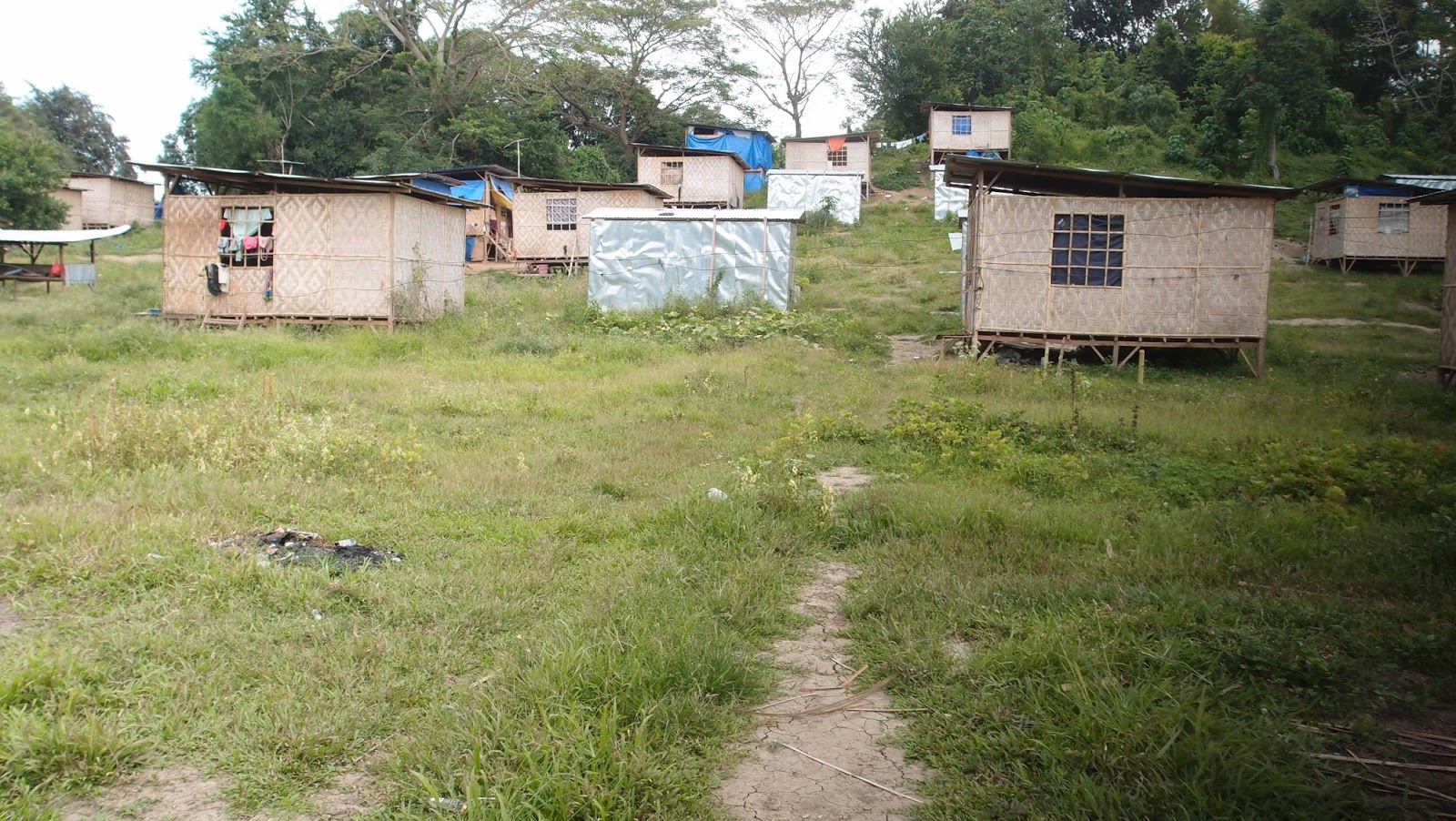
Amakan house
Today, my research team - an interpreter/research assistant, my daughter and I - visited an amakan village on the other side of the city. It's called an amakan village because the walls of the houses are made of amakan (bamboo). The walls are lightweight and well-suited to rapid construction and demolition - a key criterion of temporary housing. At its peak, the village housed over 200 households (roughly 1000 men, women and children survivors of Typhoon Sendong). Only 62 families currently reside there. The remaining families are scheduled to move into permanent relocation housing by April or June of this year.

Amakan houses and empty spaces where amakan houses once stood
The answers of the residents to my research questions were fascinating. It is not their answers, however, that I want to share in this post; it is their questions.

At the end of each interview and focus group discussion, I ask respondents what (if any) questions they have for me. About half of the respondents don't have any questions and prefer to move on with the rest of their day. Of the respondents who elect to pose questions, most inquire about the research itself or how I am enjoying life in the Philippines. If Ada is with me, then I am often asked "lalaki or babae?" (boy or girl), "how many months?", and "is the father Pinoy?". This 'second interview' typically lasts only several minutes.

Today, the second interview was much longer. There was a back and forth of questions, a comedic  performance, a round of pass-the-baby, and peals of laughter. I tried to answer the questions as fully and truthfully as I could but I didn't have all the answers. Here's a smattering of their queries.

They inquired about the Canadian climate and weather:
  • What kind of precipitation is there in Canada?
  • How cold is it?
  • Do you like snow and cold?
  • What are the seasons in Canada?
  • Do people freeze in the wintertime?
Other questions delved into family and personal matters:
  • Do you have more children?
  • How old are you?
  • Where do you stay here in the Philippines?
  • When did you arrive in the Philippines?
  • Where is your husband? What does he do here?
  • What is your husband's job? Does he have a salary here in the Philippines?
Then, there were the food questions:
  • Do you eat rice?
  • Why don't you eat rice three times a day?
  • What do you eat?
  • Is it true that there are people in the USA who only eat fruits and vegetables and bread?
  • What is your favourite Filipino food?
There were questions about social issues in Canada:
  • Are there poor people in Canada?
  • Is there a social safety net for poor people and unemployed people in Canada? Does the government provide them with free housing?
  • How does the welfare system work?
And, some questions about transportation:
  • How long does it take to get to the United States? By car? By plane?
  • Are there buses in Canada?
  • How do people travel long distances in Canada?
Other inquiries focused on their observations of foreigners (i.e. white) in the Philippines:
  • Why do foreign men like Filipina women? 
  • Why do foreigners always walk [instead of taking a motorella, jeepney, habal-habal (motorbike)]  even when it is so hot and only 7 to 10 pisos?
  • Why do American men walk so fast - like this [imitation of a man taking enormous strides]? His Filipina wife has to walk so fast just to keep up [imitation of a women hurrying around taking four or five tiny steps just to keep up with the husband], and she's usually pregnant [arm gestures to indicate a pregnant belly].
The questions you ask can reveal a lot about you, perhaps even more than the response. It's an issue I've considered in the process of designing and carrying out my research. In asking respondents to take a turn as the interviewer, I can learn about values, stereotypes, cultural biases, among other things. And, in answering questions, I can satisfy their curiosity and hopefully help to nurture cross-cultural understanding.

And now my closing questions to you:
  • How would you have answered the above questions?
  • What question(s) do you have?

Thursday, February 28, 2013

Tuesday run

Late Tuesday afternoon,
walking down Mahogany Road,
beads of sunscreen and sweat collecting dirt and car exhaust, I mull over the day's work.

It was a long day of interviews in barangay Carmen:
- the city police department
- the regional fire department
- sari-sari owners whose shops sport new renovations and fresh red and white paint courtesy of Coca Cola - a drunk trisikad (pedicab) driver trying to score a free ticket to Canada
- a thoughtful young trisikad driver
(The latter two, survivors of Typhoon Sendong)

A lunchtime discussion with my translator about the confused reactions of the trisikad drivers when asked the pros and cons of their livelihood:
"Why ask such a question? It's a job. If we don't work, we don't eat. There's nothing to like or complain about."

And one interview in the downtown hub of Divisoria
There was a late start to the interview with the director of the Xavier Ecoville Resettlement Site;
A visit from Philippine President P'noy to the resettlement site takes precedence.

Back at the house, there is a request for roasted manok (chicken) for dinner ...
It is Tuesday after all and we only buy rotisserie chicken on Tuesdays
"Why?"
It just happened that way, and is now an unofficial house rule.

The chicken is on the other side of the highway.
I volunteer to buy it on the way back from a run.

It's my first run in a few days.
The summer heat, a persistent cough, fatigue from nighttime nursing, and long days of interviews and note-writing have dampened by enthusiasm for early morning jogs.

I turn left onto the national highway, away from the city and towards barangays of Agusan and Puerto.
The shoulder is uneven, a mixture of broken asphalt, rocks and litter.
It is shared,
- by overloaded transport trucks waiting for the magical hour of 5 PM when the traffic cops call it a day and stop issuing tickets
- by jeepneys, motorellas, trisikads dropping off passengers and picking up new ones
- by roadside vendors selling everything from mosquito repellent and bananas to fresh fish and hair ties
- by schoolchildren and workers returning home
But no other runners.

A few K later I dash across to the road leading up to a new housing development.
The road is paved all the way up to Teakwood Hills;
A project of Congressman Rufus Rodriguez, according to the billboards.
The pavement ends less than one hundred metres past the gate.
There are residential roads inside, but only two houses.
But lots of vacant lots.

Not unexpectedly, the road to Teakwood Hills is hilly, steep in some parts and only a slight incline in others.
The road is marked with stations of the cross.
(Many roads branching off the highway and into the mountainous hinterlands are pilgrimage routes.)
By the time I pass Station III, my calf and hamstring muscles are burning.

A brief reprieve on some flats, where a group of children play.
Three boys and one girl are wearing only one slipper (flip flop);
The mates are on the road at varying distances from the children.
They play a version of bowling, in which the object of the game is to knock over a can with a pitched slipper. Another dozen or so children watch.

"Americano, Americano"

One of the boys abandons the game and joins me, matches me stride for stride.
We run one station of the cross together, then he stops.

On the way down, I spot the kids again.
They have been climbing up the hill.
All wear two slippers.
The boy rushes out in front, I slip in behind, and the rest of the kids behind me:
A parade, a posse of runners.
The laughter is louder than the footfalls.

A "whoooooshing" sound interrupts, then clippity-clop, clippity-clop, clippity-clop.
A tall chestnut mare gallops into the fray.
Luckily for us, she stays on the opposite side of the road.
She carries no rider, only a frayed rope tied around her neck.
The rope undulates at the same rhythm as her captive.
The equine gracefully exits the run.
The children follow.

The return trip is quick.
I feel lighter, even laden with manok.

Sunday, February 17, 2013

The Youth Guide to Biodiversity

Here's some shameless self-promotion on one of the projects I helped produce for the Food and Agriculture Organization of the United Nations (FAO) and the Convention on Biological Diversity (CBD).

*      *      *      *      *
The Youth Guide to Biodiversity is finally here!

Discover the wonders of the world’s plants and animals in this brand-new, colourful, information-packed publication. Learn about biodiversity and what it does for us, and let the Youth Guide inspire you to help protect the marvelous natural world around us.

Enjoy it, share it, get involved! Follow this link. 


*      *      *      *      *
Biodiversity Challenge BadgeThe biodiversity challenge badge, published back in 2010, is the complement to the youth guide.

The challenge badge is a tool to allow teachers and youth leaders to guide young people in learning about biodiversity and developing action-oriented projects. The activities encourage participants to get to know the natural world in their community, to find out why certain species and habitats are struggling to survive, and to understand the links between biodiversity and the well-being of people around the world.

Try it out. Follow this link.

Tuesday, February 12, 2013

Academic publications, or Ada's first lecture

Publishing in peer-reviewed journals is a critical component of academic life. The old adage of publish or perish rings true for many university lifers. Your credibility, reputation and ability to garner scholarships, research grant money, tenure and promotions all depend, in part, having your research evaluated by your peers. There is a seemingly endless list of journals publishing research on an equally impressive array of topics. These journals are ranked in terms of their impact factor. For example, getting published in a journal like Nature or Science is akin to winning an Olympic medal. Scholars typically aim to publish in both very specialized journals read only by their peers and high impact journals with an extensive readership. In addition to publishing in peer reviewed journals, academics must also share their work orally - at conferences and workshops, guest lectures, in undergraduate and graduate courses. 

During my doctoral studies I need to buoy up the academic publication and presentation section of my curriculum vitae. This post is a brief account of one such foray.

*     *     *     *
Part I: The article

Last year, I co-authored a paper with Dr. James Ford, one of my profs at McGill University. It investigates one part of the climate migration puzzle, specifically how to provide protection for the people displaced by climate change. The following abstract summarizes the main arguments of the paper.

Climate change is expected to increase migration flows, especially from socially and environmentally vulnerable populations. These 'climate migrants' do not have any official protection under international law, which has implications for the human security of migrants. This work argues that the United Nations Framework Convention on Climate Change (UNFCCC) can and should recognize climate migrants, and is the most relevant international framework for doing so. While not legally binding, the acknowledgment of climate displacement, migration and planned relocation issues in the UNFCCC's Cancun Adaptation Framework indicates a willingness to address the issue through an adaptation lens. Herein, the paper proposes a framework for setting the institutional groundwork for recognizing climate migrants, focusing on the most vulnerable, promoting targeted research and policy agendas, and situating policies within a comprehensive strategy.

If you want to read the full article, it's available on the Environmental Research Letters (ERL) website. ERL is an open access journal, which means that you can read and download articles for free. An added perk of open access journals (to academics) is that your research is more likely to be disseminated outside the academic community. 

For a short synopsis, try reading Liz Kalaugher's article on the environmentalresearchweb.org website. This online magazine targets a non-academic audience so the writing style is much less academic and reader-friendly. 

*     *     *     *
Part II: The presentation

One of my key informants at Ateneo de Manila University kindly invited me to present this paper as part of their social sciences guest lecture series. I jumped at the opportunity. But it didn't unfold exactly as planned.

The lecture was set for Friday January 25 at 4:30 pm. As luck would have it, Frank received a text message from the MSI service center earlier that week, informing him that the long-awaited hard drive for our beleaguered laptop was finally ready for pick-up. We were in Manila for only a few days; Friday was the only available day for pick-up. Because the trek to the MSI office entails a short stint on the body-crushing MRT (Metro Rail Transit), bringing Ada was not an option. So Ada spent the day with me.

After a delicious lunch of bulalo (Filipino beef marrow soup) at Jek's Kubo (including a complimentary bowl of the broth and vegetables for "the cute baby with blue eyes"), Ada and I set off for Ateneo. We arrived early, with lots of time to peruse library resources and to photograph the outdoor art installation of quirky giant animals made of wire and coloured cans. I orated an abridged version of the presentation to a pair of giraffes.

Ada sandwiched between two giant giraffes at Ateneo de Manila University
Shortly before the scheduled start time I asked a fellow student if he'd hold the baby during the presentation. He replied that it would be his pleasure. As the lecture hall filled up, Ada started to fuss. She was getting into one of those moods, the one in which she refuses to be held by anyone except mom and papa. 

I sent a frantic text to Frank.

When I was introduced, the remarks included the usual info - name, degrees, country of origin, research interests, etc. The remarks also included some commentary about changing gender relations (in which the father takes time off work to care for the children), work-life balance, parental leave in Quebec, and conducting research with a baby. 

I walked up to the podium, notes in one hand, baby in the other. I don't remember much about the words alternately flowing and stumbling from my lips. I do remember bouncing my daughter up and down on my hip, listening to her babble into the microphone, watching her make eyes at the audience. I remember feeling mortified and guilty; the guilt comes from wondering whether or not I am exerting white privilege by bringing my baby to work and expecting others to ignore the inconvenience. I remember stealing frequent glances at the door, willing Frank to enter the room.

A half hour later he does. Waltzes down the stairs to the podium, picks up the baby and exits the room. 

My knight in shining armor is also my yaya (Filipino term for nanny).

Despite (or perhaps because of) the distraction of my co-presenter, the lecture was well-received. I am very grateful that everyone I have met here in the Philippines, without exception, has been extremely understanding and receptive to accommodating a baby. Even when it entails listening to a lecture delivered (in part) by a seven and a half month old.

Reference: Christine Gibb and James Ford (2012) Should the United Nations Framework Convention on Climate Change recognize climate migrants? Environ. Res. Lett. 7 doi: 045601

Sunday, January 6, 2013

Postcards from Camiguin

A one week break from all research activities on a beautiful volcanic island in Northern Mindanao.

December 21
Greetings from Kingfisher Cottage in barangay Agoho!

After an exhaustive day of traveling, we are settling in nicely at our new abode. We had an early start to the day - with the intention of arriving in Camiguin early to mid afternoon. Our plans, however, were thwarted by:
a) an uncanny absence of taxis looking for passengers to drive into the city,
b) traffic entering CDO,
c) a long line-up of passengers waiting to alight the CDO-Balingoan bus (which worked in our favour by giving us time to use the bus station's CR (comfort room) - the cleanest public bathrooms I have ever seen in the Philippines), d) traffic leaving CDO,
e) construction on the national highway,
f) an hour delay in the ferry departure, and
g) an aging ferry whose running time, we are told, has increased steadily from one hour to two hours in the past few years.
We were glad to have asked Ralph, one half of the German-Filipino couple who own the cottage, to pick us up at the Benoni wharf.
Our first glimpse of a mist-covered Camiguin Island from the Baligoan-Benoni ferry.
On the way, we stop at the "one decent grocery store" to pick up some supplies in the capital town of Mambajao. There's a small combined wet (fish and meats) and dry (vegetables, fruits and rice) market across the road. We buy a few bags of pre-cut mixed vegetables for a stir-fry (at ten pisos a bag, it's a steal), some potatoes and a few skewers of barbecued pork (10PhP), fresh tuna (25PhP) and a fish whose name escapes me (30PhP). Masarap (delicious)!

Iggy
Daylight was fast fading by the time we left the ferry terminal. The beauty and charm of the island remains a secret ... at least until tomorrow.

P.S. Frank noticed two lizards perched atop the ceiling beam over the kitchenette. We named the larger one 'Iggy' and the smaller one 'Pop'. We enjoyed (and will continue to enjoy every night of our stay in Camiguin) watching them clamour after moths. They appeared to enjoy watching us too, and perhaps even amused when we try to engage them in conversation.


December 22
Maayong odto (good noontime) from Mambajao.

Today's the day for wandering the streets of the capital city, sampling local fare and strolling along the beach. The carabao (water buffalo) in the rice paddies along the beach fascinate Frank. The picture below is one he snapped from the beach looking up towards one of the island's majestic volcanoes, Mount Hibok-Hibok.


December 23
Today we experienced the world from a whole new perspective ... underwater. There's a beach resort / dive centre called Camiguin Action Geckos just down the hill from our cottage. It offers introductory SCUBA courses; your first dive is at one of the island's incredible coral reefs. After watching an educational video (that was probably made in the eighties or early nineties judging from the hairstyles), we hopped in a jeepney and headed to the Catarman dive site on the southwest side of the island. Exploring the reef is like jumping into a BBC nature special - except you get the full sensory experience, complete with the taste of salt water when your respirator escapes your mouth. Fish and coral of every imaginable shape and size, and more colourful than a painter's palette.

A roadside carinderia lunch included a delicious monggo bean and cabbage soup. The woman who sold it to us generously shared the recipe. (We're planning on trying it when we get back to CDO.)

In the afternoon, Frank had his turn underwater. He explored a reef just off White Island, near Action Geckos. Among the marine life he saw were two sea snakes and the silhouette of a sea turtle.


December 24
Joyeux Noel!

It's raining (again). It's amazing how the weather is so different from Cagayan de Oro City, less than one hundred kilometers away. CDO has not had a single full day of rain since we arrived mid November, while we have not yet experienced a sunny day in Camiguin.

A rainy day is a great day for visiting one of the island's waterfalls. We opt for the highest ones: Katibawasan Falls. It's a 75m drop. We charter a motorella for a 'special trip'. The lack of good maps and street signs means that you're less likely to get lost if you ride public transit than if you venture out on your own with the tourist map.

The young boy riding shotgun in the motorella wore an Armani t-shirt. His father, the driver, probably makes less than 200PhP a day. Armani clothes are probably sold for bargain prices at the town ukay-ukay (used clothing market).

At the falls, there is a group of physiotherapy students from South Korea. They are volunteering in CDO. They tell us the water is cold, but wonderful for a swim. The water is definitely colder than what we've grown accustomed to here in the Philippines, but infinitely warmer than the Quebec rivers we kayak in early spring.

One of several pools at Ardent Hot Springs
We spend the latter part of the afternoon relaxing in the warm soothing pools of Ardent Hot Springs. The natural pools are warmed in the neighbouring Mount Hibok-Hibok volcano. If you concentrate, you can smell a faint whiff of sulphur, but it's not the overpowering stench of rotten eggs. There are a series of beautiful little pools and waterfalls the same temperature as a baby's bathwater. Ada revels in this gigantic bathtub.

P.S. Tonight was Frank's night for handwashing diapers. Daily diaper washing has become a necessity because it takes so long for the diapers to dry in such a wet and humid climate. Before going to bed, Frank jokes that he never imagined that his first Christmas Eve in a tropical paradise would include such a dirty job.

December 25
Merry Christmas from Kingfisher Cottage! 

It's another rainy day so we've opted for a leisurely day.  Breakfast is French toast (the preferred breakfast of dads-on-parental-leave), fresh pineapple and mango, and instant coffee. After eating, we opened a few gifts while listening to the Puppini Sisters Christmas album. Ada's favourite present was the box.


The cottage owners, Ralph and Suzie, invited us to a Christmas lunch buffet. Like other family-based gatherings in the Philippines, there were copious amounts of food.  We spent several hours eating and conversing with a dozen or so guests. We had a particularly interesting discussion with a Camiguin-based couple, a Swiss man married to a Filipina woman, about grandfather aged foreign men starting a second family with a several decades younger Filipina woman.

I managed to sneak in a short run up to Ardent Hot Springs then down to Action Geckos before dinner. It was raining, so it felt like a late spring run in Montreal ... except for the coconut trees, roosters and pigs.

View of White Island from Kingfisher Cottage

December 26
Kamusta ka!

Despite soaring temperatures, we enjoyed a white Christmas. We spent late morning and early afternoon (with the time difference, this morning can be considered December 25 in Canada) on White Island, a gorgeous white sand island about a kilometer from the coast.

We shared a bangka (boat) from the mainland to the island with a newly-married couple on their honeymoon. He's from Ottawa, working in Calgary (and he's a Habs fan); she's from CDO, working in Calgary.


Frank and I took turns swimming with Ada in a shallow pool, and snorkeling around the reef. It was absolutely stunning, and we failed to notice how strong the sun had become. Only the baby, in her full-body UV suit and Australian lifeguard-inspired hat managed to escape sunburn.
Lesson learned!


December 27
Have you ever wondered about giant clams? They are perhaps one of the most awe-inspiring life forms.

Our visit to Cantaan Kabila White Beach Giant Clam Sanctuary was the most amazing day of the trip. Six of the nine species of giant clams found worldwide are raised here. The small entry fee pays for the maintenance of the centre and its research activities, and provides a source of livelihood for locals. It's more profitable for locals to maintain this biodiverse gem as an ecotourism destination than to harvest its marine life to sell at the market.

A visit begins with a short introductory biology lesson on the life history of the clams, and is followed by a tour of several aquariums with giant clams and fresh water tilapia. After, a local guide takes visitors on a "snorkel tour" of the giant clam sanctuary and reef. Even though the reef was partially destroyed by Typhoon Pablo, it still boasts some of the best snorkeling on Camiguin. You have to be especially careful where you step because the force of a giant bivalve slamming shut can easily sever a limb.

After snorkeling, we ate the best and probably freshest meal we've had: calamari, grilled emperor fish and Filipino-style chop suey (vegetables). The sanctuary maintains a fish pen where they raise fish for their restaurant. They catch a few fish or squid each day to transform into gourmet meals for hungry snorkelers.

December 28
Sniff, sniff. It's time to leave this tropical paradise and head back 'home' to Cagayan de Oro City. We're excited to see our CDO family again, but will miss adventuring in Camiguin.