Friday, March 8, 2013

International Women's Day

March 8th is International Women's Day. It began near the turn of the twentieth century when women in the USA began actively asserting against women's oppression and inequality (with men). It is now celebrated around the world. This year's theme is "a promise is a promise: time for action to end violence against women." (If you want to read more about the history of International Women's Day, check out this website.)

Because my research uses a feminist geography lens, and because I'm generally interested in gender and feminist issues, I was keen to partake in the International Women's Day events here in Cagayan de Oro City.

The Northern Mindanao chapter of Gabriela hosted a rally in Divisoria, the city centre. According to its website, Gabriela Philippines is "a nationwide alliance of more than 200 women's organizations that cut across sectors and regions". Since 1984, Gabriela has led the struggle of Filipinas for freedom and democracy. The Gabriela organizers I have met over the past few months have helped me better understand the political and domestic situation of women in this country.

Today's event builds on the 1 Billion Rising campaign that was launched on Valentine's Day. The campaign calls attention to violence against women and girls, and refuses to accept this violence as a given, demanding a change. On February 14th, the campaign aimed to have one billion men and women from all around the world rise up and dance. And they did.

Gabriela's unity statement for the 2013 International Women's Day calls attention to the "oppressive conditions that have been plaguing the Filipina women - poverty, hunger, structural violence, discrimination and the general lack of opportunities for women" (emphasis in original). On page two there are a few lines about the situation of women and children survivors of Typhoon Sendong: "in our region, 'Sendong' survivors especially mothers and children suffer still in relocation sites and danger zone communities. Access to livelihood, water, electricity, school and other social services remains a persistent problem." From what I've been told in interviews, and observed in site visits, this statement rings true.
Calling for action and change at the IWD event
When Ada and I arrived at in Divisoria, there were one hundred plus women, men and children sitting in the park, listening attentively to the speeches. Many participants wore pink or black t-shirts stamped with the campaign logo. Throughout the afternoon, Gabriela leaders and sympathetic partylist political candidates read unity statements. Their calls for action were received with enthusiastic cheering. A spirited version of the 1 Billion Rising choreography interspersed the speeches. Most of the crowd had mastered the choreography, suggesting they had participated in last month's campaign launch.

Not surprisingly, the crowd was filled with individuals apparently very sympathetic to the women's cause. It was, however, not who was present that is especially telling, but rather who was absent. There were no politicians - municipal, regional or national. There were no hoards of university students (easily identifiable by their school uniforms), even though the main gates of Xavier University stand less than 200 meters from the microphone. There were no individuals wearing religious garb. There were no Muslim women (although Muslim Filipinas do participate actively in other Gabriela campaigns int he Philippines). There were no army, police or fire units. There was one photographer, and no film crew. 

Tomorrow morning, the Region X Police is hosting a fun run to raise money and awareness for abused women. If I can wake up early enough to run, I expect to see a very different crowd and experience a very different vibe at the state-sponsored event.

Wednesday, March 6, 2013

Do you eat rice?

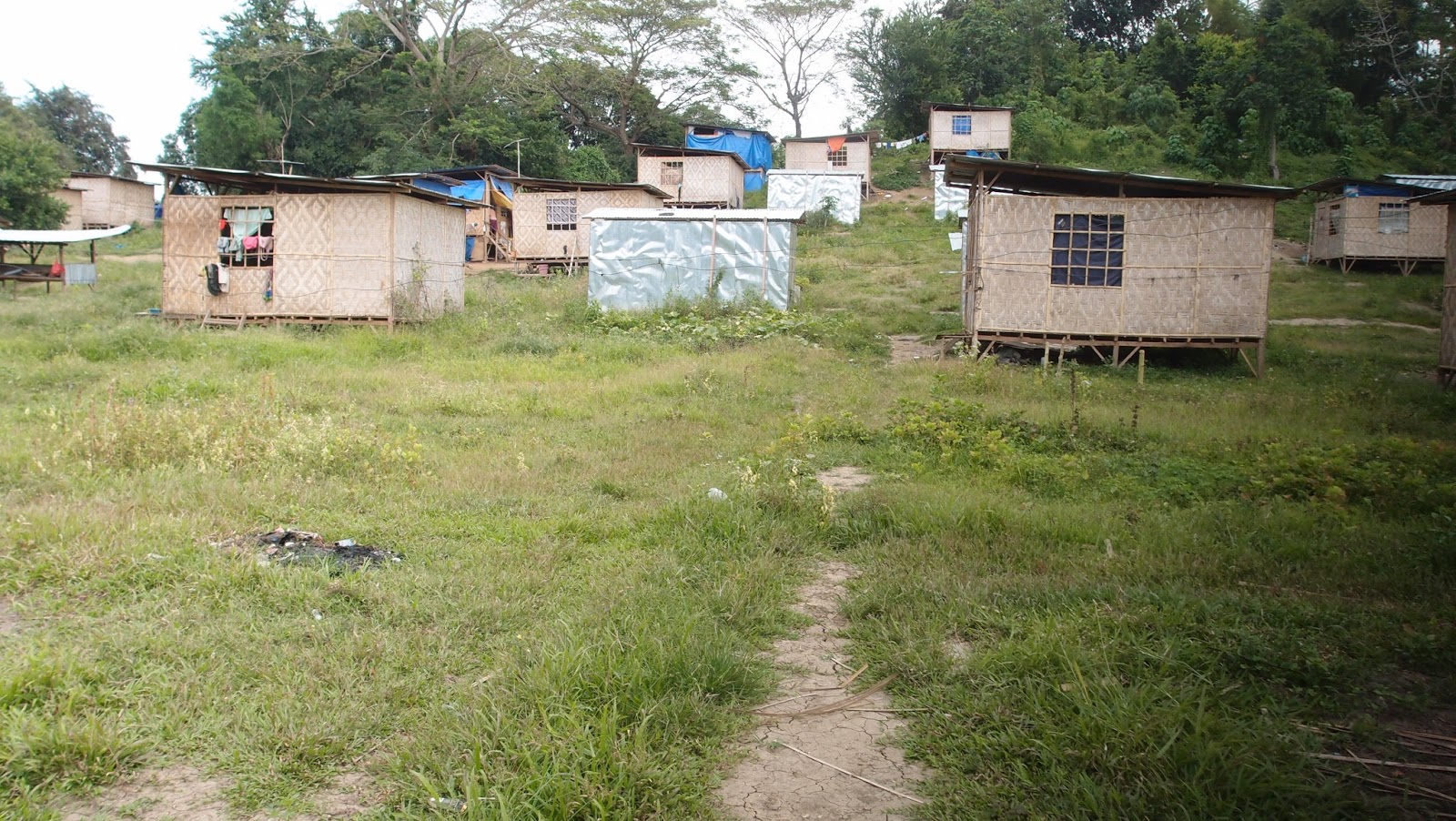
Amakan house
Today, my research team - an interpreter/research assistant, my daughter and I - visited an amakan village on the other side of the city. It's called an amakan village because the walls of the houses are made of amakan (bamboo). The walls are lightweight and well-suited to rapid construction and demolition - a key criterion of temporary housing. At its peak, the village housed over 200 households (roughly 1000 men, women and children survivors of Typhoon Sendong). Only 62 families currently reside there. The remaining families are scheduled to move into permanent relocation housing by April or June of this year.

Amakan houses and empty spaces where amakan houses once stood
The answers of the residents to my research questions were fascinating. It is not their answers, however, that I want to share in this post; it is their questions.

At the end of each interview and focus group discussion, I ask respondents what (if any) questions they have for me. About half of the respondents don't have any questions and prefer to move on with the rest of their day. Of the respondents who elect to pose questions, most inquire about the research itself or how I am enjoying life in the Philippines. If Ada is with me, then I am often asked "lalaki or babae?" (boy or girl), "how many months?", and "is the father Pinoy?". This 'second interview' typically lasts only several minutes.

Today, the second interview was much longer. There was a back and forth of questions, a comedic  performance, a round of pass-the-baby, and peals of laughter. I tried to answer the questions as fully and truthfully as I could but I didn't have all the answers. Here's a smattering of their queries.

They inquired about the Canadian climate and weather:
  • What kind of precipitation is there in Canada?
  • How cold is it?
  • Do you like snow and cold?
  • What are the seasons in Canada?
  • Do people freeze in the wintertime?
Other questions delved into family and personal matters:
  • Do you have more children?
  • How old are you?
  • Where do you stay here in the Philippines?
  • When did you arrive in the Philippines?
  • Where is your husband? What does he do here?
  • What is your husband's job? Does he have a salary here in the Philippines?
Then, there were the food questions:
  • Do you eat rice?
  • Why don't you eat rice three times a day?
  • What do you eat?
  • Is it true that there are people in the USA who only eat fruits and vegetables and bread?
  • What is your favourite Filipino food?
There were questions about social issues in Canada:
  • Are there poor people in Canada?
  • Is there a social safety net for poor people and unemployed people in Canada? Does the government provide them with free housing?
  • How does the welfare system work?
And, some questions about transportation:
  • How long does it take to get to the United States? By car? By plane?
  • Are there buses in Canada?
  • How do people travel long distances in Canada?
Other inquiries focused on their observations of foreigners (i.e. white) in the Philippines:
  • Why do foreign men like Filipina women? 
  • Why do foreigners always walk [instead of taking a motorella, jeepney, habal-habal (motorbike)]  even when it is so hot and only 7 to 10 pisos?
  • Why do American men walk so fast - like this [imitation of a man taking enormous strides]? His Filipina wife has to walk so fast just to keep up [imitation of a women hurrying around taking four or five tiny steps just to keep up with the husband], and she's usually pregnant [arm gestures to indicate a pregnant belly].
The questions you ask can reveal a lot about you, perhaps even more than the response. It's an issue I've considered in the process of designing and carrying out my research. In asking respondents to take a turn as the interviewer, I can learn about values, stereotypes, cultural biases, among other things. And, in answering questions, I can satisfy their curiosity and hopefully help to nurture cross-cultural understanding.

And now my closing questions to you:
  • How would you have answered the above questions?
  • What question(s) do you have?

Thursday, February 28, 2013

Tuesday run

Late Tuesday afternoon,
walking down Mahogany Road,
beads of sunscreen and sweat collecting dirt and car exhaust, I mull over the day's work.

It was a long day of interviews in barangay Carmen:
- the city police department
- the regional fire department
- sari-sari owners whose shops sport new renovations and fresh red and white paint courtesy of Coca Cola - a drunk trisikad (pedicab) driver trying to score a free ticket to Canada
- a thoughtful young trisikad driver
(The latter two, survivors of Typhoon Sendong)

A lunchtime discussion with my translator about the confused reactions of the trisikad drivers when asked the pros and cons of their livelihood:
"Why ask such a question? It's a job. If we don't work, we don't eat. There's nothing to like or complain about."

And one interview in the downtown hub of Divisoria
There was a late start to the interview with the director of the Xavier Ecoville Resettlement Site;
A visit from Philippine President P'noy to the resettlement site takes precedence.

Back at the house, there is a request for roasted manok (chicken) for dinner ...
It is Tuesday after all and we only buy rotisserie chicken on Tuesdays
"Why?"
It just happened that way, and is now an unofficial house rule.

The chicken is on the other side of the highway.
I volunteer to buy it on the way back from a run.

It's my first run in a few days.
The summer heat, a persistent cough, fatigue from nighttime nursing, and long days of interviews and note-writing have dampened by enthusiasm for early morning jogs.

I turn left onto the national highway, away from the city and towards barangays of Agusan and Puerto.
The shoulder is uneven, a mixture of broken asphalt, rocks and litter.
It is shared,
- by overloaded transport trucks waiting for the magical hour of 5 PM when the traffic cops call it a day and stop issuing tickets
- by jeepneys, motorellas, trisikads dropping off passengers and picking up new ones
- by roadside vendors selling everything from mosquito repellent and bananas to fresh fish and hair ties
- by schoolchildren and workers returning home
But no other runners.

A few K later I dash across to the road leading up to a new housing development.
The road is paved all the way up to Teakwood Hills;
A project of Congressman Rufus Rodriguez, according to the billboards.
The pavement ends less than one hundred metres past the gate.
There are residential roads inside, but only two houses.
But lots of vacant lots.

Not unexpectedly, the road to Teakwood Hills is hilly, steep in some parts and only a slight incline in others.
The road is marked with stations of the cross.
(Many roads branching off the highway and into the mountainous hinterlands are pilgrimage routes.)
By the time I pass Station III, my calf and hamstring muscles are burning.

A brief reprieve on some flats, where a group of children play.
Three boys and one girl are wearing only one slipper (flip flop);
The mates are on the road at varying distances from the children.
They play a version of bowling, in which the object of the game is to knock over a can with a pitched slipper. Another dozen or so children watch.

"Americano, Americano"

One of the boys abandons the game and joins me, matches me stride for stride.
We run one station of the cross together, then he stops.

On the way down, I spot the kids again.
They have been climbing up the hill.
All wear two slippers.
The boy rushes out in front, I slip in behind, and the rest of the kids behind me:
A parade, a posse of runners.
The laughter is louder than the footfalls.

A "whoooooshing" sound interrupts, then clippity-clop, clippity-clop, clippity-clop.
A tall chestnut mare gallops into the fray.
Luckily for us, she stays on the opposite side of the road.
She carries no rider, only a frayed rope tied around her neck.
The rope undulates at the same rhythm as her captive.
The equine gracefully exits the run.
The children follow.

The return trip is quick.
I feel lighter, even laden with manok.

Sunday, February 17, 2013

The Youth Guide to Biodiversity

Here's some shameless self-promotion on one of the projects I helped produce for the Food and Agriculture Organization of the United Nations (FAO) and the Convention on Biological Diversity (CBD).

*      *      *      *      *
The Youth Guide to Biodiversity is finally here!

Discover the wonders of the world’s plants and animals in this brand-new, colourful, information-packed publication. Learn about biodiversity and what it does for us, and let the Youth Guide inspire you to help protect the marvelous natural world around us.

Enjoy it, share it, get involved! Follow this link. 


*      *      *      *      *
Biodiversity Challenge BadgeThe biodiversity challenge badge, published back in 2010, is the complement to the youth guide.

The challenge badge is a tool to allow teachers and youth leaders to guide young people in learning about biodiversity and developing action-oriented projects. The activities encourage participants to get to know the natural world in their community, to find out why certain species and habitats are struggling to survive, and to understand the links between biodiversity and the well-being of people around the world.

Try it out. Follow this link.