Showing posts with label Canada. Show all posts

Tuesday, November 12, 2013

Canada's response to Supertyphoon Haiyan (Yolanda)


A Philippine flag flutters atop the control tower of a damaged airport after super Typhoon Haiyan battered Tacloban city, in the central Philippines. Haiyan is possibly the strongest typhoon ever to hit land.
Photo: Romeo Ranoco/Reuters
It is heart-wrenching to listen to the stories of survivors of Supertyphoon Haiyan (or Yolanda as it is known locally in the Philippines), and to the stories of Montrealers who haven't yet been able to get in touch with their loved ones in the affected parts of the Central Visayas. At this point, I feel like the only things I can do are to continue trying to get in touch with my friends and acquaintances in Tacloban, Cebu and St Bernard, to donate to disaster relief efforts, and to urge the Canadian government to strongly support relief and recovery efforts. So, I wrote to my Member of Parliament, Mr. Marc Garneau, this morning. Here is that letter.


Dear Mr. Garneau, 

As one of your constituents in the riding of Westmount - Ville-Marie, I strongly urge you to take an active stand in Ottawa in pledging more and immediate support for the communities affected by Supertyphoon Haiyan in the Philippines. The disaster affects me personally and professionally, and I am extremely disappointed by the paltry response of the Government of Canada thus far.

My doctoral research explores how Filipinos rebuild their lives and livelihoods after a disaster. Since 2010, I have spent nearly a year in the Philippines visiting communities affected by disasters, interviewing survivors, and learning about critical issues and challenges. Everywhere I went, I was received with warmth, kindness and generosity. Everywhere I went, the resilience and ingenuity of Filipinos emerged as common strategies for living with uncertainty. I expect that the survivors of Haiyan will exhibit these same traits, but the effectiveness of these traits in rebuilding lives and livelihoods will be limited without significant and thoughtful financial assistance in both the short
 and long terms.

As of Monday November 11, the Government of Canada has announced support for two funds to help relief efforts in the Philippines: one fund of up to $5 million for humanitarian relief (14 cents per Canadian), and another fund that matches the donations of Canadians to registered Canadian charities between November 8 to December 8. Yesterday,  it committed to deploy Canada's Disaster Assistance Response Team (DART). I think Canada's promise to help is grossly inadequate and ignores the importance of the Philippines to Canada. Please permit me to explain.

The Philippines provides a lot of human capital to Canada. It is now the number one source country for immigrants to Canada. Manitoba, Saskatchewan,  Alberta and British Columbia all have formal labour agreements with the Philippines. A similar agreement for the Atlantic provinces is underway. Many of the caregivers who care for Canadian children and elderly are Filipinos, providing a vital service that Canadians are unwilling or unable to do. Many more Filipinos or Canadians of Filipino descent work in engineering, health care and other sectors of the Canadian economy.

The strong interests of the Canadian mining sector in the Philippines vastly outweigh the pledged humanitarian response. The latest (2008) published statistics from the Mines and Geosciences Bureau of the Philippines indicate Canadian mining companies invested more than 1.2 billion dollars in Philippine mining projects (table 1). Although these mining sites do not lie within the path of the supertyphoon, maintaining goodwill between Canada and the Philippines is important to the social license Canadian mining companies require to operate overseas. Moreover, the revenues and repatriation of copper, gold, silver, nickel profits to Canada are surely worth hundreds of millions, if not billions of dollars to Canadian companies. A donation of
 up to five million dollars and an undetermined amount of matching dollars is minute in comparison to the mineral wealth mined and repatriated to Canada. A significant response to the current disaster would indicate Canada cares about the people and not just the mineral wealth of the Philippines.

Table 1: Canadian Mining Companies Operating in the Philippines
Source: Mines and Geosciences Bureau of the Philippines
LOCATION
TENEMENT HOLDER/ PERMITTEE/ OPERATOR
TOTAL DISCLOSED PROJECT COST
(million $)
Sitio Canatuan, Bgy. Tabayo, Siocon, Zamboanga del Norte
TVI Resources Development Philippines Inc.
57.57
Maco, Compostela Valley
Apex Mining Corp. Inc (Crew Gold)
36.58
Victoria, Mindoro Oriental
Crew Minerals
1,100.09
Jabonga, Santiago, Tublay, Agusan del Norte*
MRL Gold Phils., Inc.
3.15
Balabag, Bayog, Zamboanga Sibugay
TVI Resources Development Philippines Inc.
2
Bgy. Camanlangan, New Bataan, Compostela Valley
Philco Mining Corporation (Sur American)
5
Sitio Capcapo, Licuaan-Baay, Abra
Jabel Corporation (Kadabra Mining Corp., Olympus Pacific Minerals, Inc.)
48
Bgy. Balibago, Lobo, Batangas
MRL Gold Phils., Inc.
4.45
Bgy. Balibago, Lobo, Batangas
MRL Gold Phils., Inc.
2.02
Camanlangan, Panay and Fatima New Bataan, Compostela Valley
Philco Mining Corporation (Sur American)
0.1
Bgy. Camanlangan, New Bataan, Compostela Valley
Philco Mining Corporation (Sur American)
0.1
Malimono and Mainit, Surigao del Norte
MRL Gold Phils., Inc.
0.1
TOTAL
1,259.16
Source: Isa Lorenzo and Philip Ney. 2008. The Canadian quandary. Philippine Center for Investigative Journalism. 28 December 2008. http://pcij.org/stories/the-canadian-quandary/

While I laud the government's pledge to match the generosity of Canadians supporting disaster relief efforts, I expect that the amount the government pays out will be drastically lower than what Canadians actually contribute. This is because the majority of money sent by people with a direct Philippines connection will not go through a registered Canadian charity. Instead, the money will be channeled as remittances sent directly to family, friends and Filipino organisations working at the grassroots level. Thus the GOC will pay comparatively little to the money wired through global payment service companies like Western Union, MoneyGram, WorldRemit and others.

Finally, why did the government wait until 11 November, three days after Haiyan made landfall in Eastern Samar on 8 November, before deploying the DART? The Tropical Storm Risk website began issuing alerts about Haiyan on 4 November. The DART should have been deployed last week to Japan, to be ready and in the Philippines on Saturday, right after the storm passed. It would not have cost Canadian taxpayers any more money, and most importantly, it could have helped to mitigate the emerging crisis due to clean water and food shortages, and severely damaged communication and infrastructure systems. With storms becoming more and more destructive, I expect my government to adjust its response to effectively deal with disasters, which requires a proactive stance. Stephen Harper claims his Conservative government is the best option for managing money; delivering food and water after the people have died is not effective. As such, the current government is living in the past; I want a government that is prepared for the present and the future.

Given the strong existing ties between Canada and the Philippines and what I understand as the moral obligation of Canada, I strongly urge you to speak up on behalf of Canadians who want their federal government to take more and immediate action to support short-term disaster relief and long-term recovery in the Central Visayas.

Thank you.  Sincerely, 
Christine 


CC: Justin Trudeau (Liberal Party Leader), Thomas Mulcair (NDP Party Leader), Stephen Harper (PM), Elizabeth May (Green Party Leader), Daniel Paillé (Bloc Québecois Party Leader), Christian Paradis (Minister of International Development and Minister for La Francophonie), John Baird (Minister of Foreign Affairs) , Tobias C. Enverga Jr. (Conservative Senator), Jean François Bouthillette (Radio Canada reporter), Leslie Gatan (Philippine ambassador to Canada), Robert Desjardins (Canadian ambassador to the Philippines)

Tuesday, March 19, 2013

Mending nets, sewing (sowing) relationships

Today's interviews were at the Cala-anan resettlement site. It's one of the largest resettlement sites in CDO, and is home to former residents from many different barangays. When I tell people that I'm studying the different places where the survivors of Typhoon Sendong went, and what they have done for their livelihoods, a typical response is "have you been to Cala-anan?"
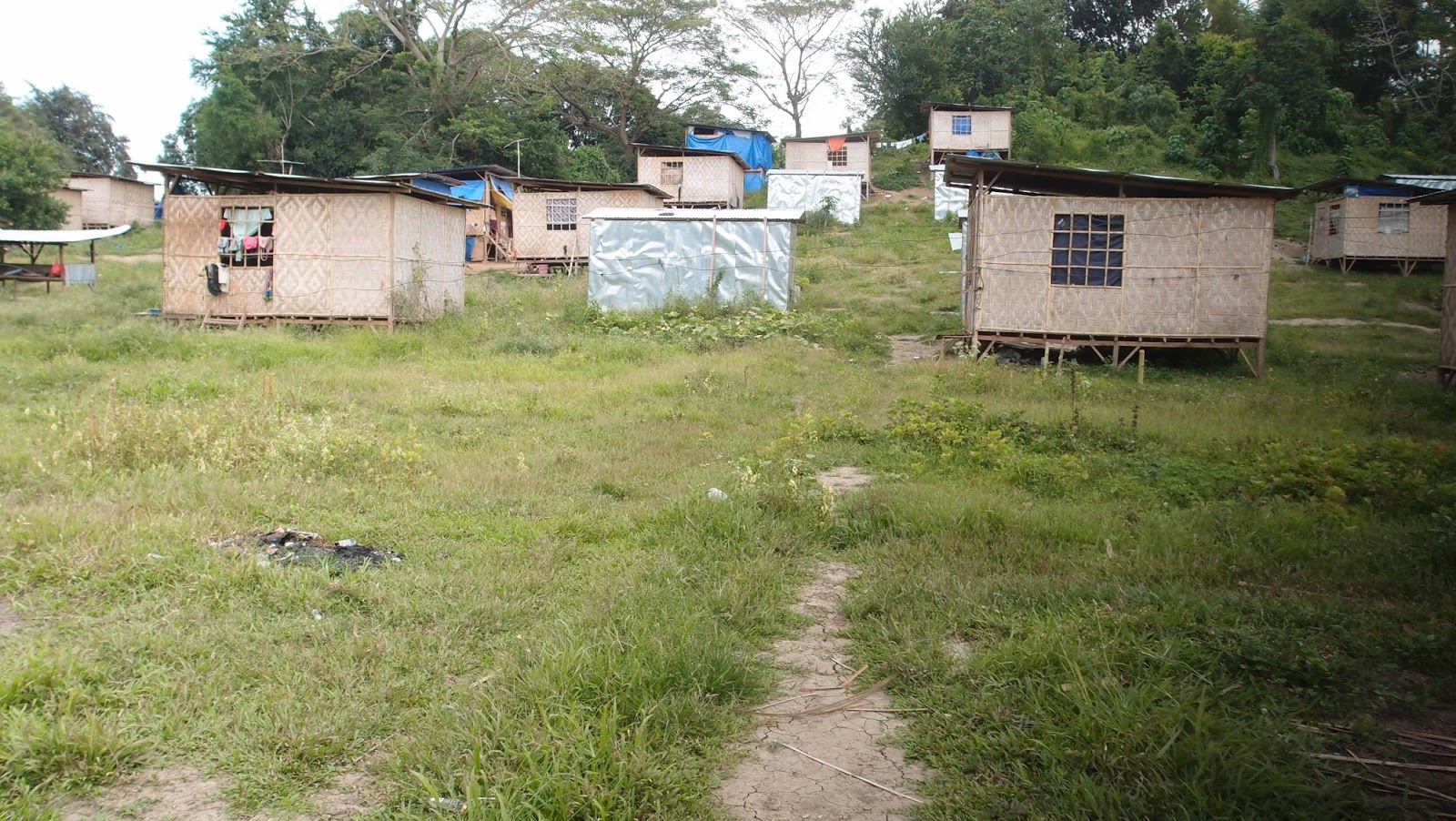
Relocation housing in Cala-anan
From the city's main market, it's a 40 minute (15P) jeepney ride. My translator, Ada and I rode a jeepney that was nearly empty when it left the terminal. This is highly unusual; most drivers will wait until the jeep is full or nearly full before departing. We stop frequently, picking up passengers. We pass the giant landfill site (site of tomorrow's interviews), the turnoff to a transitional housing area and another relocation site.

Along one of the side streets, in the doorway of her row house, sits an older woman. She is mending a net. Instead of thread she uses fine wire, carefully stitching the mesh to a round metal frame. The net is pink. Attached to the frame is a long, thin metal handle. It looks sturdy, yet light.

When we reach the part of the interview about livelihoods, and changes she has experienced in her livelihoods before and after Sendong, I ask her about the net. Her former barangay is next to the sea; I am anticipating to learn that she used to mend fishing nets (likely for a fisherman husband or son), and continues to do so in her new home. That the person using the net doesn't fish as frequently as before, because of the distance and added expense of commuting from such a distance.

I'm wrong.

The net is unrelated to her livelihood. Her apo (grandchildren) like to fish in the creek on the other side of the road. Their enthusiasm for fishing (the act of fishing, not necessarily catching anything) means there are many nets to repair. It makes her happy to make her apo happy.

When I look at the net again, it looks familiar. Not one of the store-bought butterfly nets you see in nature stores. No, it more closely resembles the handmade nets my Grandpa made for his grandchildren. The nets that my cousins and I used to catch minnows and crayfish in Lake Superior, and the chipmunks and squirrels that ventured onto one of bird (squirrel) feeders at camp. The nets that gave us endless hours of planning, practicing, failing and finally catching creatures. The nets that, more importantly, encouraged us to play and run around together for hours and hours and hours. The nets that Grandpa would repair again and again (the squirrels had a tendency to chew through the nets in their quest for freedom).

When I watch the woman mend the fish net with this insight, I see her sewing with something other than potential income or food as her motivation. It's something that money cannot buy. In mending this net, she is sowing relationships - among her apo, and between her and her apo.

Wednesday, March 6, 2013

Do you eat rice?

Amakan house
Today, my research team - an interpreter/research assistant, my daughter and I - visited an amakan village on the other side of the city. It's called an amakan village because the walls of the houses are made of amakan (bamboo). The walls are lightweight and well-suited to rapid construction and demolition - a key criterion of temporary housing. At its peak, the village housed over 200 households (roughly 1000 men, women and children survivors of Typhoon Sendong). Only 62 families currently reside there. The remaining families are scheduled to move into permanent relocation housing by April or June of this year.

Amakan houses and empty spaces where amakan houses once stood
The answers of the residents to my research questions were fascinating. It is not their answers, however, that I want to share in this post; it is their questions.

At the end of each interview and focus group discussion, I ask respondents what (if any) questions they have for me. About half of the respondents don't have any questions and prefer to move on with the rest of their day. Of the respondents who elect to pose questions, most inquire about the research itself or how I am enjoying life in the Philippines. If Ada is with me, then I am often asked "lalaki or babae?" (boy or girl), "how many months?", and "is the father Pinoy?". This 'second interview' typically lasts only several minutes.

Today, the second interview was much longer. There was a back and forth of questions, a comedic  performance, a round of pass-the-baby, and peals of laughter. I tried to answer the questions as fully and truthfully as I could but I didn't have all the answers. Here's a smattering of their queries.

They inquired about the Canadian climate and weather:
  • What kind of precipitation is there in Canada?
  • How cold is it?
  • Do you like snow and cold?
  • What are the seasons in Canada?
  • Do people freeze in the wintertime?
Other questions delved into family and personal matters:
  • Do you have more children?
  • How old are you?
  • Where do you stay here in the Philippines?
  • When did you arrive in the Philippines?
  • Where is your husband? What does he do here?
  • What is your husband's job? Does he have a salary here in the Philippines?
Then, there were the food questions:
  • Do you eat rice?
  • Why don't you eat rice three times a day?
  • What do you eat?
  • Is it true that there are people in the USA who only eat fruits and vegetables and bread?
  • What is your favourite Filipino food?
There were questions about social issues in Canada:
  • Are there poor people in Canada?
  • Is there a social safety net for poor people and unemployed people in Canada? Does the government provide them with free housing?
  • How does the welfare system work?
And, some questions about transportation:
  • How long does it take to get to the United States? By car? By plane?
  • Are there buses in Canada?
  • How do people travel long distances in Canada?
Other inquiries focused on their observations of foreigners (i.e. white) in the Philippines:
  • Why do foreign men like Filipina women? 
  • Why do foreigners always walk [instead of taking a motorella, jeepney, habal-habal (motorbike)]  even when it is so hot and only 7 to 10 pisos?
  • Why do American men walk so fast - like this [imitation of a man taking enormous strides]? His Filipina wife has to walk so fast just to keep up [imitation of a women hurrying around taking four or five tiny steps just to keep up with the husband], and she's usually pregnant [arm gestures to indicate a pregnant belly].
The questions you ask can reveal a lot about you, perhaps even more than the response. It's an issue I've considered in the process of designing and carrying out my research. In asking respondents to take a turn as the interviewer, I can learn about values, stereotypes, cultural biases, among other things. And, in answering questions, I can satisfy their curiosity and hopefully help to nurture cross-cultural understanding.

And now my closing questions to you:
  • How would you have answered the above questions?
  • What question(s) do you have?

Tuesday, June 14, 2011

Le coeur de Vancouver

Lorsqu'on visite un nouvel endroit, nos yeux voient des choses que les résidents ne voient pas puisque ces choses sont vues tellement souvent qu'elles deviennent "normales" et une partie de l'arrière plan de la journée quotidienne de ces gens. Des images des coeurs dispersés un peu partout dans des espaces publics m'ont attirés et j'ai voulu les partager. Voici donc quelques photos des "coeurs de Vancouver". Tous ces photos ont été prises dans le "Downtown Eastside".
Une mosaïque sur le trottoir.

Un coeur peinturé au bout d'une ruelle. 

Assis sur un banc au coin d'Adamac et Commercial Drive, Mike porte un chapeau "I ♥ Canada".


Un drapeau près du bibliothèque.

Une pieuvre et un coeur sur une fenêtre sur Commercial Drive.

La clôture d'un parc au coin de Franklin et Nanaimo.

Une affiche sur Commercial Drive.


Thursday, May 19, 2011

Lost and found

This is a good news story. And a déjà vu story.

*     *     *
I am currently visiting with my sister and her boyfriend in Vancouver. (Another tangent before beginning Filipino language classes next month.) They live in the notorious Downtown Eastside. The one made famous for sky high rates of illicit drug use, HIV/AIDS, hepatitis, drug-related crime, and more recently, Insite (the supervised safe injection site). My recent experience belies such a reputation.

Sunday 
A lovely stroll through Granville Island: toy stores, flower stalls, produce stands, hat shops, quirky broom stores, Canada geese families. We stuff mangoes, strawberries, grapes, sheep feta, plantain, apples and pears into my shoulder bag and Steve's satchel. I slip my wallet into my jacket pocket.

The drizzle turns to rain. Out come the umbrellas. We speed home, trying to stay dry(ish). Dash across Terminal Road (timing the traffic lights is tricky). Make it home only mildly drenched.

Monday
I go to grab my wallet as we head out - except that I can't find it. Anywhere. We search inside and out. It is definitely gone. While personal security is not really an issue in the neighbourhood, a dropped wallet is unlikely to be returned.

The wallet would have been a pretty disappointing find for whomever picked it up as it contained less than two dollars cash. For me, the loss was more of a sentimental loss and a practical nuisance. The former because my one-of-a-kind wallet was made from recycled juice tetrapaks in the Philippines. The latter because acquiring a new driver licence, student card and health card is a tedious process (and I was nervous about boarding a plane without government-issued ID).

And thus begins the card cancelling process. My banks are surprisingly apologetic and sympathetic. In the future, if I ever want to speak with very helpful bank employees I will call the lost card hotline.

Tuesday
The phone rings, interrupting dinner. It's Dad. My sister jots down a phone number.

I call the security desk at the Tinseltown Mall. They had my wallet. A SkyTrain rider had spotted it at the Terminal Road intersection near the train station, and had brought it to the mall security. Security had contacted one of my banks, who then had contacted my parents.

Later that evening, after a riveting panel discussion on "Health, harm reduction and the law: the Insite case" at Simon Fraser University, we retrieve the wallet. Everything's there.

A sigh of relief and a smile. Not so much for finding the wallet, but for the evidence that people care.

*     *     *
I have no idea of the identity of the good Samaritan who turned in the wallet, or that of the other security and bank people who played a role in tracking me down. To you, I am grateful. Thank you for your honesty, kindness and time.

*     *     *
There's a déjà vu element to the story. A decade or so ago, I left my wallet in the back seat of a New York City taxi. And got it back. Fully intact.

Wednesday, May 11, 2011

Diaspora, an intellectual tangent

One of the perks of being a graduate student is the flexibility of your schedule. The academic life is rarely a nine to five endeavour. While the end-of-semester paper writing and exam marking crunch exacts very long days (and nights), in other periods, students may find themselves with the time to pursue what I call "intellectual tangents". This post is a reflection on one such pursuit.

*     *     *
Whenever I see the word diaspora, I'm inclined to speak the word aloud. Diaspora. It rolls off the tongue easily, yet it does not leave the mouth entirely. There's a part that remains, that clings on. Much like members of a diaspora - people who leave one place without severing all ties to that place.

On May 9, the University of Ottawa's African Studies and Research Laboratory hosted a free public workshop on "Migration and the New African Diaspora". It intrigued me for a number of reasons, notably its focus on migration and place-making and my long-standing  interest in the African continent. The workshop promised to foster discussion and debate on three issues:
  1. Identity: should we talk of the African diasporas as a single entity or are there a variety of African diasporas?
  2. The role of national and international institutions in making diasporas 'actors of development' in their countries of origin.
  3. Existing local initiatives, made possible as a result of transnational dynamics rather than institutionalisation of diasporas.
What is a diaspora? The official workshop documentation defines it as "a collective dispersed throughout the world whose members maintain relations with one another and who are involved in one or a number of projects concerning their home country". Each of the panellists added their own understanding of the concept, reflecting its diverse theoretical and instrumental applications: "an imagined community that is neither here nor there",  "a fractious collective that recreates institutions, cultural emblems and tensions found in the homeland", "a means to support co-development, in which diaspora members integrate into (Canadian) society and  help to develop their home country" and "a group whose money and minds can help to solve underdevelopment". Members of the diasporas can be refugees or asylum-seekers, students studying at foreign universities or economically-motivated immigrants. As such, a diaspora is a heterogeneous group.

Why is interest in diasporas growing? From a development delivery perspective, the African diasporas can infuse cash, skills and knowledge. Since the 1990s, the monetary value of remittances that the Africa diasporas send to help their families and communities and to invest has quadrupled. Remittances eclipse the amount of money that developed countries spend on development in Africa. The World Bank's diaspora program facilitates (1) the creation of an enabling environment (e.g. market-friendly reforms to attract investment), (2) increased remittances through lower transaction costs and greater transparency, and (3) brain gain initiatives. In other words, the World Bank values diasporas for their financial assets. It is shifting the burden of financing development from developed countries like Canada and intergovernmental institutions like the World Bank to individuals with a vested interest (emotional, financial or otherwise) in the African continent.

The African diasporas are also being courted by development agencies, funding organisations and governments. The opinions of the former are sought to inform policy, funding and investment decisions made by the latter. The power wielded by the diasporas is not unnoticed by African governments, some of which actively encourage diaspora members to lobby for particular policies in their adopted countries. 

Investigating African diasporas is a way of understanding blackness. As one of the panellists pointed out, there are no "Blacks" in Africa, only "Algerians", "Kikuyus" (in Kenya), "Namibians", "Congolese", et cetera. Blackness is not the defining aspect of one's identity until one leaves the continent. The basis for identity is transformed from a nation (or other defining quality) to a colour. The panellist drew parallels between the trajectory of becoming Black with the process of becoming a woman. When renown feminist scholar Simone de Beauvoir wrote that "one is not born, but rather becomes, a woman", she asserted that societal influences trump biology in articulating what constitutes a woman and femininity. Applied to the African diasporas, this observation means that it is society - people, institutions, organisations, culture, norms, media, ... - that dictates what is means to be Black. The process and concept of blackness is not merely an academic exercise. It has real implications for citizenship and belonging in both origin and receiving countries.

Panellists and audience members alike were highly critical of underlying assumption of homogeneity. The motivation for migration for intentional migrants is clearly different from that of their refugee and displacee counterparts. Will all these people perceive the homeland in the same way? Will their children and grandchildren? Do Liberians living in neighbouring Ivory Coast support a development pathway identical to their compatriots living in China? If they differ, whose views should guide policy? The World Bank and other organisations seeking to invoke an entrepreneurial and humanitarian spirit in diasporas presuppose a singular voice. They do not recognise the plurality of voices, or "polyvocality" in the African diasporas. These organisations similarly presume diaspora members espouse common values, and do not account for differences based on gender, age, class, education, et cetera. This glossing over of differences is not unlike the popular treatment of Africa as a country, instead of as an enormous continent housing an incredible amount of diversity (see map below). (Herein the irony of this blog post's undifferentiated referral to "Africa" and use of an "Africa" label is duly noted.)  
Flag-inspired political map of Africa.
Source: Northern by Nature

*     *     *
As with any tangent, it is helpful to bridge a seemingly unrelated pursuit with the overarching one. For my own research on environmental displacement and migration in the Philippines, this "intellectual tangent" provides much food for thought. Migration, both internal and international, has long been a part of the Filipino way of life. Currently, the national government has policies encouraging its population to work abroad as "Overseas Filipino Workers" or OFWs. Not only do the remittances that OFWs send back to the Philippines help families and communities, but they are also an important source of foreign investment and foreign currency to grow the economy and to repay the national debt, respectively. These OFWs, as well as the Filipinos who have laid down permanent roots in other countries, also send back ideas. Thus, to understand national and sub-national disaster and migration policies and programmes requires, I must be aware of the networks operating at the transnational scale and their influence in shaping initiatives at the local to national level.

*     *     *
Postscript 1:
The workshop was bilingual, with presenters and audience members switching (nearly) effortlessly between English and French. Some things were better expressed in French, others in English. The bilingualism added a layer of richness and inclusiveness to the workshop. It made an impression on me. When I am frustrated by the limitations of my French language skills and am second guessing my choice to do a doctorate in a second language (which inevitably happens from time to time), I will picture myself in that workshop room.

Postscript 2: 
There will be a follow-up workshop (date and specific theme TBD). I will post any links to summary reports or other workshop-inspired material as it is made available.